

Where we really are in the AI cycle
The AI cycle may feel advanced, but the Polar Capital Global Technology team believes the opposite. As AI evolves from chatbots to autonomous agents capable of completing complex workflows, adoption, investment and enterprise demand are accelerating rapidly.

Three and a half years after ChatGPT launched, it is tempting to assume the AI cycle is well advanced. We believe the opposite. In our view, 2026 looks less like the middle of the cycle than its beginning. This is the point at which AI moves from a productivity tool used by relatively few to a general-purpose technology that reshapes how work is organised, and where value is created, across every sector of the global economy.
The easiest way to underestimate AI is to mistake the interface for the capability. For most investors, ‘AI’ is still the chat window: a tool that drafts emails, summarises documents and writes code, or an enhanced version of search. Those productivity gains are real, but anchoring to the current interface systematically underestimates both the scale of the underlying capability and the duration of the cycle ahead.
Early use cases for transformative technology are often lightweight, even trivial. Consider the early decades of electricity. When the telegraph was commercialised in the 1840s, investors were right to be excited, but the telegraph was a poor preview of what electricity would become. It was one narrow application of a far more general capability and it gave little hint of the electric light, refrigerated food, the factory motor or the wholesale reorganisation of industries that followed. The most meaningful productivity gains from electrification also only arrived once factories were redesigned around distributed power, instead of bolting electric motors onto layouts inherited from the age of steam.
Today’s chat interface is the telegraph: a real but narrow use of the underlying capability. That capability – machine cognition that is becoming abundant and increasingly autonomous – is the electricity. Much of the value may accrue not to the technology itself but to the companies in every sector that reorganise and innovate around it, and that reorganisation has barely begun. This is why we believe the cycle is closer to its start.
The agentic inflection
The critical development of the past 12 months is the arrival of agentic AI that completes work autonomously across extended, multi-step tasks. Enterprises run on repetitive, complex workflows that are too complex for a single prompt yet do not need human judgement at every step. Unlike a chatbot, agentic AI can plug into existing systems and own these processes end to end and deliver their outcomes.
Goldman Sachs estimates that by 2030 agentic AI could drive token consumption 24x higher than current levels.
The evidence is concrete. The length of task an AI agent can reliably complete has been doubling roughly every four months, from under a minute in 2022 to nearly 15 hours for Anthropic’s Claude Opus 4.8 today. Google is processing 3.2 quadrillion tokens per month, according to Alphabet CEO Sundar Pichai at its annual developed conference, Google I/O 2026, a 330x increase in two years, driven in large part by the shift to reasoning models and agentic workflows that multiply token consumption per interaction. These figures are not Google-specific. This is an accelerating step-change in AI consumption that, in our view, the market continues to underestimate.
Coding has been the first domain to demonstrate this at scale, partly because feedback is unambiguous – code either runs or not – and partly because training data is abundant. Claude Code went from effectively zero to around 4% of all public GitHub commits within 13 months. More significantly, what looks like faster coding is better understood as the removal of the human bottleneck from software production: without that constraint, output becomes a function of compute, not headcount. This non-human scaling has moved AI into a genuinely new phase.
The commercial validation is equally striking. Goldman Sachs estimates that by 2030 agentic AI could drive token consumption 24x higher than current levels. That is not a projection about the distant future but an extrapolation from trends already visible in the data. Average AI token spend among Ramp's 50,000 corporate customers has increased 13x since January 2025 alone, and now accounts for 1-2% of total corporate spend on the platform. This speaks to a broader and accelerating step-change in the velocity of AI consumption globally and supports our view that inference demand is being structurally underestimated by the market.
Still early in a long cycle
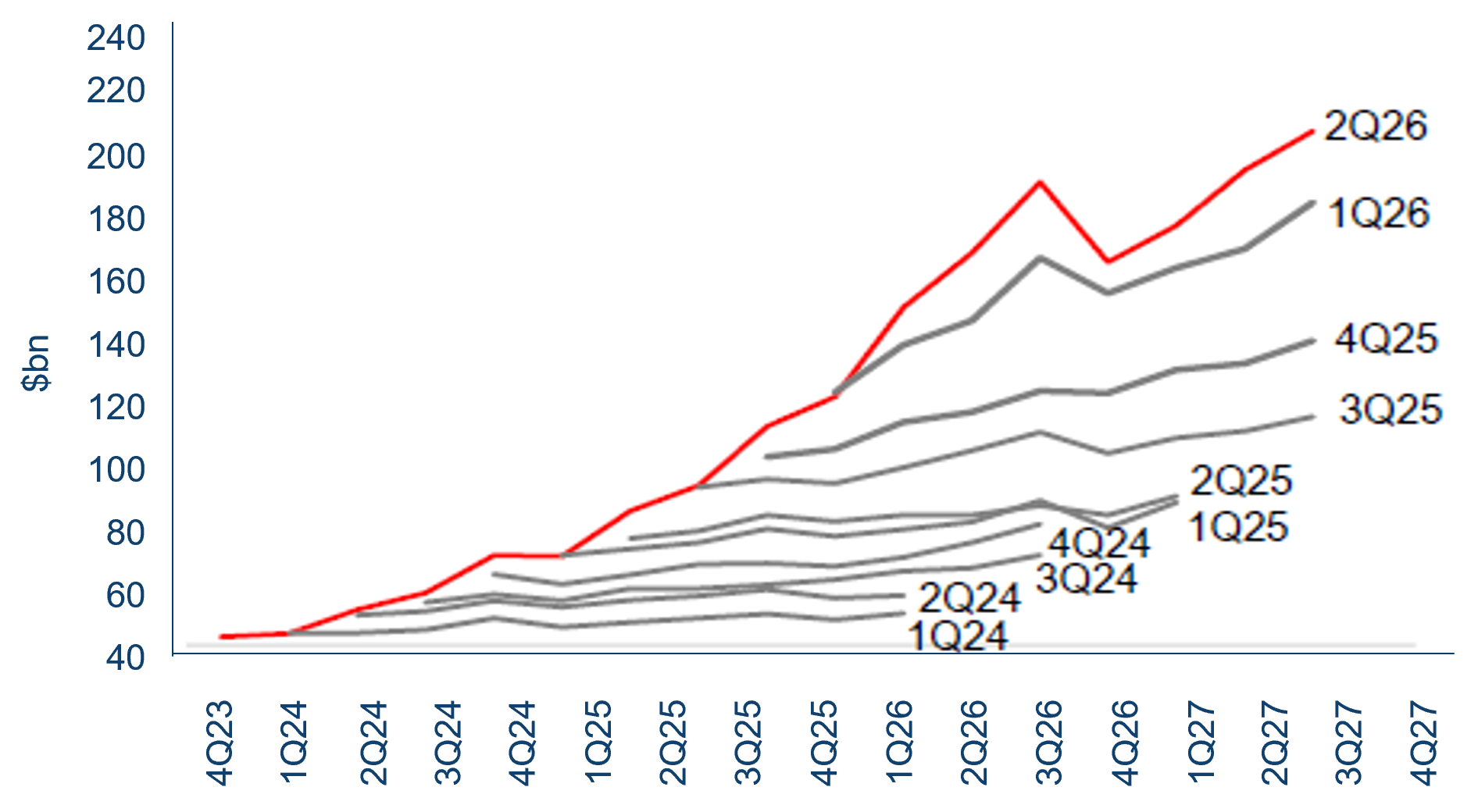
AI spending today represents approximately 1% of global gross domestic product (GDP). Historical precedent suggests peak intensity could reach 2-5% over a cycle lasting at least 5-10 years. Morgan Stanley sees a potential $10trn AI infrastructure buildout over the full cycle, roughly 10x the mobile and cloud capital expenditure (capex) of the previous era. Set against $44trn of knowledge worker expenditure and $60trn of corporate operating costs, today’s spending looks like an early instalment rather than a peak.
| Hyperscale quarterly capex estimates since 20241 |
 |
| Source: Polar Capital, April 2026. 1.Wells Fargo Securities, LLC, FactSet, 3 May 2026. Past performance is not indicative or a guarantee of future returns. Forecasts are based upon subjective estimates and assumptions about circumstances and events that may not yet have taken place and may never do so. |
Frontier lab revenue trajectories make this very clear. Anthropic’s annualised revenue run rate was $1bn 16 months ago and crossed $47bn in May 2026 – to our knowledge, the fastest business-to-business revenue ramp in the history of software. This is not being driven by speculation. The structural case for the cycle to continue is compelling: scaling laws have held for over a decade, the cost of a given level of intelligence is falling by roughly 10x a year and AI is now beginning to accelerate its own development.
The structural reasons for expecting the cycle to run further are threefold. First, scaling laws – the empirically observed relationships between compute, data, model parameters and capability – have remained intact for over a decade, driving capability improvements at roughly 10x the pace of Moore's Law. Each generation of frontier model is materially better than the last. Anthropic's confirmation of its Mythos model – a meaningful step-change across coding, reasoning and cybersecurity benchmarks – points firmly to continued progress. We are only now seeing the first models trained on NVIDIA's Blackwell architecture, with further capability gains expected as larger clusters of more powerful hardware come online through 2026-27.
Second, AI is now beginning to accelerate its own development. Claude Code is c90% self-written, and Anthropic's productivity platform Cowork was built almost entirely with Claude Code in roughly 10 days. The recursive loop of AI improving AI is compressing model iteration cycles in a way with few historical parallels.
Third, 84% of the world's population has never used AI and enterprise adoption – which is where the economic value concentrates – has only begun to inflect in the past two quarters.
The supply picture is also worth noting. We believe capacity constraints serve, at least in the near term, to prevent this investment cycle from becoming a bubble. TSMC's relatively conservative 2026 capex of $52-56bn, combined with the multi-year lead times required to construct hyperscale data centres and connect the necessary power, means supply growth remains structurally constrained even as demand accelerates. High-end graphics processing unit (GPU) spot prices have reflected this: the price of NVIDIA’s Blackwell B200 GPU has nearly doubled in the past two months and the rollout of higher per-token (the basic units of text an AI model processes) pricing plans by the leading labs is a further signal that demand continues to overwhelm available supply. This is not the profile of a market pricing in speculation but rather, we believe, the profile of a market in which real demand is running ahead of real supply.
The frontier model layer is, in our view, the critical strategic asset of the agentic era, the operating system on which everything else runs.
The scale of capital commitment reinforces the structural case. Combined hyperscaler capex of more than $750bn is expected in 2026, scaling towards $1trn or more in 2027. These figures appear reasonable when set against the size of the markets ultimately being addressed. A wave of capital markets activity, including Anthropic's $65bn Series H fund raise at a $965bn valuation, initial public offering (IPO) filings from both Anthropic and OpenAI expected, and the successful SpaceX listing should further underpin confidence in the cycle's durability and draw broader institutional capital into the AI investment thesis.
Where the investment opportunity sits
For us, this framework has meaningful implications for portfolio positioning. We continue to hold a constructive, pro-AI stance which we view as early in a multi-year structural growth cycle.
The frontier model layer is, in our view, the critical strategic asset of the agentic era, the operating system on which everything else runs. Any company without a frontier model is building on someone else's infrastructure, exposed to margin compression and rapid obsolescence as the cost of code converges on zero, in our view. The infrastructure layer High-end GPU spot prices have reflected this: B200 prices have nearly doubled in the past two months – semiconductors, data centres, power, networking and the supply chain supporting them – represents the most visible near-term opportunity. NVIDIA's results announced in May illustrate both the demand environment and the durability of that case: 85% year-on-year revenue growth, a fifth consecutive quarter of accelerating growth and guidance for the next quarter implying 95% year-on-year growth.
At the same time, disruption risk is real and increasingly visible. The pre-AI digital profit pools – software; information services; digital advertising; e-commerce – face structural pressure from abundant code, non-human actors operating on a different cost curve and a natural language interface that progressively unbundles users from incumbent applications. We have materially reduced software exposure in the portfolio as a result.
The deeper point is one of framing. The risk in assessing this cycle is not that investors are too excited but that they are anchoring their expectations to the current interface rather than the underlying capability. Applying a productivity-tool framework to a general-purpose technology systematically undervalues both the duration and the eventual scale of what is ahead. Anthropic's finding of 80% median time savings on multi-step cognitive tasks, applied to the addressable portion of the $23trn developed-world knowledge wage bill, implies a potential AI revenue opportunity of $1.5-1.6trn at a conservative capture rate. Today's industry revenue sits below 1% of that figure.
We strongly believe we are still early in a rare moment of discontinuous technological progress, where decades of normal innovation are compressed into months, the impact of which is hard to comprehend and continues to be widely underestimated. The low-hanging fruit has not been picked. We have barely entered the orchard.