
Quis custodiet ipsos custodes – ‘Who watches the watchers?’ A question as pertinent to bank regulation today as when Plato raised the topic in his Republic in 370BC, or when Juvenal subsequently penned the above quote in his Satires in the second century AD. 

This is particularly relevant given recent comments from Michelle Bowman, Vice Chair for Supervision at the Federal Reserve (Fed), on the failure of Silicon Valley Bank (SVB), alongside the initial findings of the Starling Advisory Group’s independent review1.

What happened with SVB

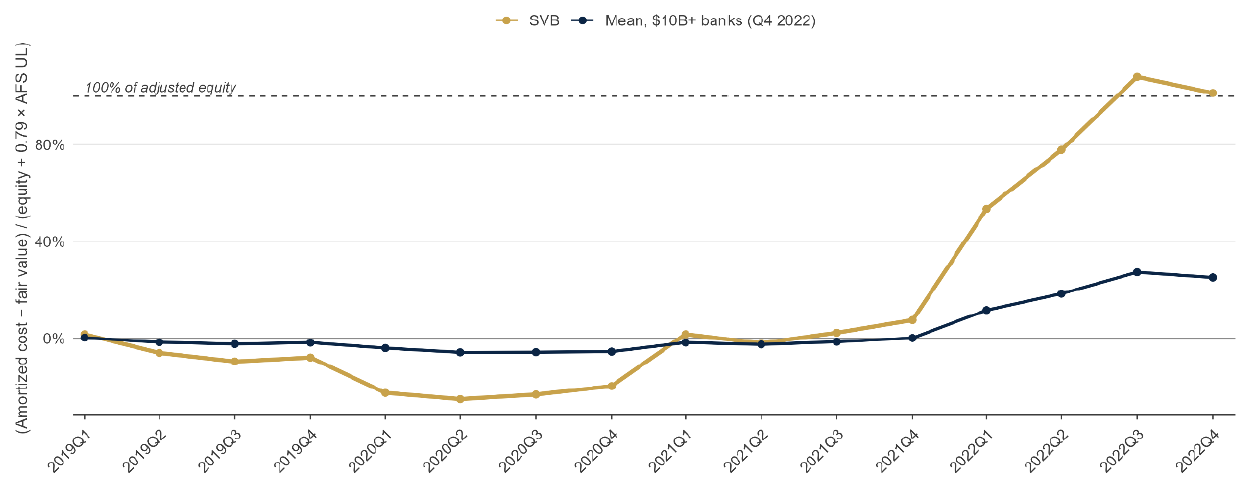
SVB’s vulnerabilities predated its failure in March 2023. Between 2019 and 2021, the bank’s assets almost tripled, from $71bn to $211bn, with much of the deposit growth invested in longer-duration securities. As interest rates rose, the value of these assets fell, creating unrealised losses. By the end of 2022, these losses exceeded the bank’s capital base, while 94% of deposits were uninsured and concentrated among specific clients.

Following the announcement of a $1.8bn loss on securities sales and plans to raise $2.25bn of capital, depositors withdrew more than $40bn (around 25% of the deposit base) on 9 March. With a further $100bn of withdrawals expected the following day, regulators closed the bank on 10 March2. 

Unrealised securities losses as a share of adjusted equity3
Unrealised securities losses as a share of adjusted equity
Source: Probative Inquiry 2023 Financial Sector Stress Events, Starling Advisory Group; September 2026

What was the Fed’s role?

Crucially, the Fed was aware of many of these risks.

From 2019 onwards, the Fed issued 54 supervisory findings against SVB. When the bank failed in March 2023, 31 remained open. Three times the number at peer firms. Deficiencies in SVB’s interest rate risk management were identified in 2020, 2021 and 2022.

However, these findings did not result in sufficiently timely action. Fed supervisors, for example, took more than seven months to develop an informal enforcement action covering governance, risk management and liquidity; the bank failed before it could be issued.

Bowman’s recent comments offer a possible explanation for the delay: “a long-standing culture of risk aversion” 4. She also noted that “…staff believed it was personally safer to take no action unless they were certain the action was exactly right”.

Casting our minds back to Plato’s Republic, Socrates compared the ideal guardians to well-bred watchdogs: gentle towards those they protected, but fierce when confronted by a threat. To us, the Fed’s supervisory culture appears to have discouraged the latter.

Improvements to oversight

Changes, however, have since been introduced. Supervisors are now directed to focus more closely on material financial risks, and less on procedural or documentation shortcomings, while the range of tools available to them has been expanded. They must also report monthly to senior supervisory officials where they are uncertain whether action is warranted, allowing concerns to be escalated rather than delayed. In Plato's terms, the intention is to restore some of the watchdog's bite.

The impact for financial credit

We believe that for bank creditors, these changes, with earlier supervisory intervention, should be supportive. Our equity colleagues may grumble at requirements to raise capital, strengthen liquidity, adjust underwriting standards or restrict distributions, but creditors typically benefit when vulnerabilities are addressed early, particularly while banks retain a wider range of options. The situation with SVB illustrates this point. Its vulnerabilities stemmed not from deteriorating asset quality but from interest rate and liquidity risk. Earlier intervention to reduce duration risk, bolster liquidity or raise capital may have come at a cost to profitability and shareholders, but could also have left the bank substantially more resilient. 

[1] Probative Inquiry 2023 Financial Sector Stress Events, Starling Advisory Group, 21 September 2026

[2] Review of the Federal Reserve’s Supervision and Regulation of Silicon Valley Bank, Fed, 28 April 2023

[3] Equity capital plus tax-adjusted available for sale (AFS) unrealised losses; mean over banks with $10bn in assets or more as of Q4 2022


[4] Initial Findings from Independent Review of Silicon Valley Bank, Vice Chair for Supervision Michelle W. Bowman, 18 September 2026

Risks

  • Capital is at risk and there is no guarantee the Fund will achieve its objective. Investors should make sure their attitude towards risk is aligned with the risk profile of the Fund before investing.
  • Past performance is not a reliable guide to future performance. The value of investments may go down as well as up and you might get back less than you originally invested as there is no guarantee in place.
  • The value of a fund’s assets may be affected by uncertainties such as international political developments, market sentiment, economic conditions, changes in government policies, restrictions on foreign investment and currency repatriation, currency fluctuations and other developments in the laws and regulations of countries in which investment may be made. Please see the Fund’s Prospectus for details of all risks.
  • The fund is exposed to Sustainability risks which are environmental, social and governance factors that could have an actual or potential material negative impact on the value of the Fund and its risk factors.
  • The Fund invests in fixed income securities, and prices can rise or fall due to several factors affecting global markets.
  • The Fund uses derivatives which carry the risk of reduced liquidity, substantial loss, and increased volatility in adverse market conditions, such as failure amongst market participants.
  • The Fund invests in assets denominated in currencies other than the Fund's base currency. Changes in exchange rates may have a negative impact on the Fund's investments. If the share class currency is different from the currency of the country in which you reside, exchange rate fluctuations may affect your returns when converted into your local currency. Hedged share classes may have associated costs which may impact the performance of your investment.
  • There may be times where the issuer or guarantor of a fixed income security cannot meet its payment obligations or has their credit rating downgraded, resulting in potential losses for the Fund.
  • The Fund may invest in emerging markets where there is a greater risk of volatility due to political and economic uncertainties, restrictions on foreign investment, currency repatriation and currency fluctuations. Developing markets are typically less liquid which may result in large price movements to the Fund.


Important Information:
This is a marketing communication and does not constitute a solicitation or offer to any person to buy or sell any related securities or financial instruments. Any opinions expressed may change. This document does not contain information material to the investment objectives or financial needs of the recipient. This document is not advice on legal, taxation or investment matters. Tax treatment depends on personal circumstances. Investors must rely on their own examination of the fund or seek advice. Investment may be restricted in other countries and as such, any individual who receives this document must make themselves aware of their respective jurisdiction and observe any restrictions.

A decision may be taken at any time to terminate the marketing of the Fund in any EEA Member State in which it is currently marketed. Shareholders in the affected EEA Member State will be given notification of any decision and provided the opportunity to redeem their interests in the Fund, free of any charges or deductions, for at least 30 working days from the date of the notification.

Investment in the Fund is an investment in the shares of the Fund and not in the underlying investments of the Fund. Further information about fund characteristics and any associated risks can be found in the Fund’s Key Information Document or Key Investor Information Document (“KID” or “KIID”), the Prospectus (and relevant Fund Supplement), the Articles of Association and the Annual and Semi-Annual Reports. Please refer to these documents before making any final investment decisions. These documents are available free of charge at Polar Capital Funds plc, Georges Court, 54-62 Townsend Street, Dublin 2, Ireland, via email by contacting Investor-Relations@polarcapitalfunds.com or at www.polarcapital.co.uk. The KID is available in the languages of all EEA member states in which the Fund is registered for sale; the Prospectus, Annual and Semi-Annual Reports and KIID are available in English.

The Fund promotes, among other characteristics, environmental or social characteristics and is classified as an Article 8 fund under the EU's Sustainable Finance Disclosure Regulation (SFDR). For more information, please see the Prospectus and relevant Fund Supplement.

ESG and sustainability characteristics are further detailed on the investment manager’s website: - https://www.polarcapital.co.uk/ESG-and-Sustainability/Responsible-Investing/.

A summary of investor rights associated with investment in the Fund can be found here.

This document is provided and approved by both Polar Capital LLP and Polar Capital (Europe) SAS.

Polar Capital LLP is authorised and regulated by the Financial Conduct Authority (“FCA”) in the United Kingdom, and the Securities and Exchange Commission (“SEC”) in the United States. Polar Capital LLP’s registered address is 16 Palace Street, London, SW1E 5JD, United Kingdom.

Polar Capital (Europe) SAS is authorised and regulated by the Autorité des marchés financiers (AMF) in France. Polar Capital (Europe) SAS’s registered address is 18 Rue de Londres, Paris 75009, France.

Polar Capital LLP is a registered Investment Advisor with the SEC. Polar Capital LLP is the investment manager and promoter of Polar Capital Funds plc – an open-ended investment company with variable capital and with segregated liability between its sub-funds – incorporated in Ireland, authorised by the Central Bank of Ireland and recognised by the FCA. FundRock Management Company (Ireland) Limited acts as management company and is regulated by the Central Bank of Ireland. Registered Address: Percy Exchange, 8/34 Percy Place, Dublin 4, Ireland.

For UK investors: The Fund is recognised in the UK under the Overseas Funds Regime (OFR) but it is not a UK-authorised Fund. UK investors should be aware that they may not be able to refer a complaint against its Management Company or its Depositary to the UK’s Financial Ombudsman Service. Any claims for losses relating to the Management Company or the Depositary will not be covered by the Financial Services Compensation Scheme, in the event that either entity should become unable to meet its liabilities to investors. For information on the complaint process to the Management Company, please see the Country Supplement for this fund available at https://www.polarcapital.co.uk/.

Benchmark: The Fund is actively managed and uses ICE BofA Global Financial Index as a reference for performance measurement. The benchmark has been chosen as it is generally considered to be representative of the investment universe in which the Fund invests. The performance of the Fund is likely to differ from the performance of the benchmark as the holdings, weightings and asset allocation will be different. Investors should carefully consider these differences when making comparisons. Further information about the benchmark can be found here. The benchmark is provided by an administrator on the European Securities and Markets Authority (ESMA) register of benchmarks which includes details of all authorised, registered, recognised, and endorsed EU and third country benchmark administrators together with their national competent authorities.

Third-party Data: Some information contained herein has been obtained from third party sources and has not been independently verified by Polar Capital. Neither Polar Capital nor any other party involved in or related to compiling, computing or creating the data makes any express or implied warranties or representations with respect to such data (or the results to be obtained by the use thereof), and all such parties hereby expressly disclaim all warranties of originality, accuracy, completeness, merchantability or fitness for a particular purpose with respect to any data contained herein.

Country Specific Disclaimers: Please be aware that not every share class of every fund is available in all jurisdictions. When considering an investment into the Fund, you should make yourself aware of the relevant financial, legal and tax implications. Neither Polar Capital LLP nor Polar Capital Funds plc shall be liable for, and accept no liability for, the use or misuse of this document.

None

Quis custodiet ipsos custodes – ‘Who watches the watchers?’ A question as pertinent to bank regulation today as when Plato raised the topic in his Republic in 370BC, or when Juvenal subsequently penned the above quote in his Satires in the second century AD. 

This is particularly relevant given recent comments from Michelle Bowman, Vice Chair for Supervision at the Federal Reserve (Fed), on the failure of Silicon Valley Bank (SVB), alongside the initial findings of the Starling Advisory Group’s independent review1.

What happened with SVB

SVB’s vulnerabilities predated its failure in March 2023. Between 2019 and 2021, the bank’s assets almost tripled, from $71bn to $211bn, with much of the deposit growth invested in longer-duration securities. As interest rates rose, the value of these assets fell, creating unrealised losses. By the end of 2022, these losses exceeded the bank’s capital base, while 94% of deposits were uninsured and concentrated among specific clients.

Following the announcement of a $1.8bn loss on securities sales and plans to raise $2.25bn of capital, depositors withdrew more than $40bn (around 25% of the deposit base) on 9 March. With a further $100bn of withdrawals expected the following day, regulators closed the bank on 10 March2. 

Unrealised securities losses as a share of adjusted equity3
Unrealised securities losses as a share of adjusted equity
Source: Probative Inquiry 2023 Financial Sector Stress Events, Starling Advisory Group; September 2026

What was the Fed’s role?

Crucially, the Fed was aware of many of these risks.

From 2019 onwards, the Fed issued 54 supervisory findings against SVB. When the bank failed in March 2023, 31 remained open. Three times the number at peer firms. Deficiencies in SVB’s interest rate risk management were identified in 2020, 2021 and 2022.

However, these findings did not result in sufficiently timely action. Fed supervisors, for example, took more than seven months to develop an informal enforcement action covering governance, risk management and liquidity; the bank failed before it could be issued.

Bowman’s recent comments offer a possible explanation for the delay: “a long-standing culture of risk aversion” 4. She also noted that “…staff believed it was personally safer to take no action unless they were certain the action was exactly right”.

Casting our minds back to Plato’s Republic, Socrates compared the ideal guardians to well-bred watchdogs: gentle towards those they protected, but fierce when confronted by a threat. To us, the Fed’s supervisory culture appears to have discouraged the latter.

Improvements to oversight

Changes, however, have since been introduced. Supervisors are now directed to focus more closely on material financial risks, and less on procedural or documentation shortcomings, while the range of tools available to them has been expanded. They must also report monthly to senior supervisory officials where they are uncertain whether action is warranted, allowing concerns to be escalated rather than delayed. In Plato's terms, the intention is to restore some of the watchdog's bite.

The impact for financial credit

We believe that for bank creditors, these changes, with earlier supervisory intervention, should be supportive. Our equity colleagues may grumble at requirements to raise capital, strengthen liquidity, adjust underwriting standards or restrict distributions, but creditors typically benefit when vulnerabilities are addressed early, particularly while banks retain a wider range of options. The situation with SVB illustrates this point. Its vulnerabilities stemmed not from deteriorating asset quality but from interest rate and liquidity risk. Earlier intervention to reduce duration risk, bolster liquidity or raise capital may have come at a cost to profitability and shareholders, but could also have left the bank substantially more resilient. 

Related Fund

Get the latest insights sent straight to your inbox

Risks

  • Capital is at risk and there is no guarantee the Fund will achieve its objective. Investors should make sure their attitude towards risk is aligned with the risk profile of the Fund before investing.
  • Past performance is not a reliable guide to future performance. The value of investments may go down as well as up and you might get back less than you originally invested as there is no guarantee in place.
  • The value of a fund’s assets may be affected by uncertainties such as international political developments, market sentiment, economic conditions, changes in government policies, restrictions on foreign investment and currency repatriation, currency fluctuations and other developments in the laws and regulations of countries in which investment may be made. Please see the Fund’s Prospectus for details of all risks.
  • The fund is exposed to Sustainability risks which are environmental, social and governance factors that could have an actual or potential material negative impact on the value of the Fund and its risk factors.
  • The Fund invests in fixed income securities, and prices can rise or fall due to several factors affecting global markets.
  • The Fund uses derivatives which carry the risk of reduced liquidity, substantial loss, and increased volatility in adverse market conditions, such as failure amongst market participants.
  • The Fund invests in assets denominated in currencies other than the Fund's base currency. Changes in exchange rates may have a negative impact on the Fund's investments. If the share class currency is different from the currency of the country in which you reside, exchange rate fluctuations may affect your returns when converted into your local currency. Hedged share classes may have associated costs which may impact the performance of your investment.
  • There may be times where the issuer or guarantor of a fixed income security cannot meet its payment obligations or has their credit rating downgraded, resulting in potential losses for the Fund.
  • The Fund may invest in emerging markets where there is a greater risk of volatility due to political and economic uncertainties, restrictions on foreign investment, currency repatriation and currency fluctuations. Developing markets are typically less liquid which may result in large price movements to the Fund.


Important Information:
This is a marketing communication and does not constitute a solicitation or offer to any person to buy or sell any related securities or financial instruments. Any opinions expressed may change. This document does not contain information material to the investment objectives or financial needs of the recipient. This document is not advice on legal, taxation or investment matters. Tax treatment depends on personal circumstances. Investors must rely on their own examination of the fund or seek advice. Investment may be restricted in other countries and as such, any individual who receives this document must make themselves aware of their respective jurisdiction and observe any restrictions.

A decision may be taken at any time to terminate the marketing of the Fund in any EEA Member State in which it is currently marketed. Shareholders in the affected EEA Member State will be given notification of any decision and provided the opportunity to redeem their interests in the Fund, free of any charges or deductions, for at least 30 working days from the date of the notification.

Investment in the Fund is an investment in the shares of the Fund and not in the underlying investments of the Fund. Further information about fund characteristics and any associated risks can be found in the Fund’s Key Information Document or Key Investor Information Document (“KID” or “KIID”), the Prospectus (and relevant Fund Supplement), the Articles of Association and the Annual and Semi-Annual Reports. Please refer to these documents before making any final investment decisions. These documents are available free of charge at Polar Capital Funds plc, Georges Court, 54-62 Townsend Street, Dublin 2, Ireland, via email by contacting Investor-Relations@polarcapitalfunds.com or at www.polarcapital.co.uk. The KID is available in the languages of all EEA member states in which the Fund is registered for sale; the Prospectus, Annual and Semi-Annual Reports and KIID are available in English.

The Fund promotes, among other characteristics, environmental or social characteristics and is classified as an Article 8 fund under the EU's Sustainable Finance Disclosure Regulation (SFDR). For more information, please see the Prospectus and relevant Fund Supplement.

ESG and sustainability characteristics are further detailed on the investment manager’s website: - https://www.polarcapital.co.uk/ESG-and-Sustainability/Responsible-Investing/.

A summary of investor rights associated with investment in the Fund can be found here.

This document is provided and approved by both Polar Capital LLP and Polar Capital (Europe) SAS.

Polar Capital LLP is authorised and regulated by the Financial Conduct Authority (“FCA”) in the United Kingdom, and the Securities and Exchange Commission (“SEC”) in the United States. Polar Capital LLP’s registered address is 16 Palace Street, London, SW1E 5JD, United Kingdom.

Polar Capital (Europe) SAS is authorised and regulated by the Autorité des marchés financiers (AMF) in France. Polar Capital (Europe) SAS’s registered address is 18 Rue de Londres, Paris 75009, France.

Polar Capital LLP is a registered Investment Advisor with the SEC. Polar Capital LLP is the investment manager and promoter of Polar Capital Funds plc – an open-ended investment company with variable capital and with segregated liability between its sub-funds – incorporated in Ireland, authorised by the Central Bank of Ireland and recognised by the FCA. FundRock Management Company (Ireland) Limited acts as management company and is regulated by the Central Bank of Ireland. Registered Address: Percy Exchange, 8/34 Percy Place, Dublin 4, Ireland.

For UK investors: The Fund is recognised in the UK under the Overseas Funds Regime (OFR) but it is not a UK-authorised Fund. UK investors should be aware that they may not be able to refer a complaint against its Management Company or its Depositary to the UK’s Financial Ombudsman Service. Any claims for losses relating to the Management Company or the Depositary will not be covered by the Financial Services Compensation Scheme, in the event that either entity should become unable to meet its liabilities to investors. For information on the complaint process to the Management Company, please see the Country Supplement for this fund available at https://www.polarcapital.co.uk/.

Benchmark: The Fund is actively managed and uses ICE BofA Global Financial Index as a reference for performance measurement. The benchmark has been chosen as it is generally considered to be representative of the investment universe in which the Fund invests. The performance of the Fund is likely to differ from the performance of the benchmark as the holdings, weightings and asset allocation will be different. Investors should carefully consider these differences when making comparisons. Further information about the benchmark can be found here. The benchmark is provided by an administrator on the European Securities and Markets Authority (ESMA) register of benchmarks which includes details of all authorised, registered, recognised, and endorsed EU and third country benchmark administrators together with their national competent authorities.

Third-party Data: Some information contained herein has been obtained from third party sources and has not been independently verified by Polar Capital. Neither Polar Capital nor any other party involved in or related to compiling, computing or creating the data makes any express or implied warranties or representations with respect to such data (or the results to be obtained by the use thereof), and all such parties hereby expressly disclaim all warranties of originality, accuracy, completeness, merchantability or fitness for a particular purpose with respect to any data contained herein.

Country Specific Disclaimers: Please be aware that not every share class of every fund is available in all jurisdictions. When considering an investment into the Fund, you should make yourself aware of the relevant financial, legal and tax implications. Neither Polar Capital LLP nor Polar Capital Funds plc shall be liable for, and accept no liability for, the use or misuse of this document.