


"A lion used to prowl about a field in which four oxen used to dwell. Many a time he tried to attack them; but whenever he came near they turned their tails to one another, so that whichever way he approached them he was met by the horns of one of them. At last, however, they fell a-quarrelling among themselves, and each went off to pasture alone in a separate corner of the field. Then the lion attacked them one by one and soon made an end of all four."
Aesop, The Four Oxen and the Lion, c6th century BC
Aesop's fable describes a simple mechanism. When conditions change, vulnerability can emerge, and once separated from the herd, targets are easily found.
Financial markets operate in much the same way. During periods of calm, weak and strong institutions can appear remarkably similar, with bonds and equities trading at comparable valuations. The herd appears uniform.
When conditions change, however, markets are quick to identify the weakest in the pack.
The collapse of Silicon Valley Bank (SVB) in March 2023 is the clearest recent example. Its failure reflected two vulnerabilities: a concentrated depositor base and significant unrealised losses in its held-to-maturity bond portfolio – a consequence of interest rate hikes, poor asset/liability management and a concentration of long-term bond holdings. The chart below illustrates both.
| US held-to-maturity losses versus uninsured deposits (FY22) |
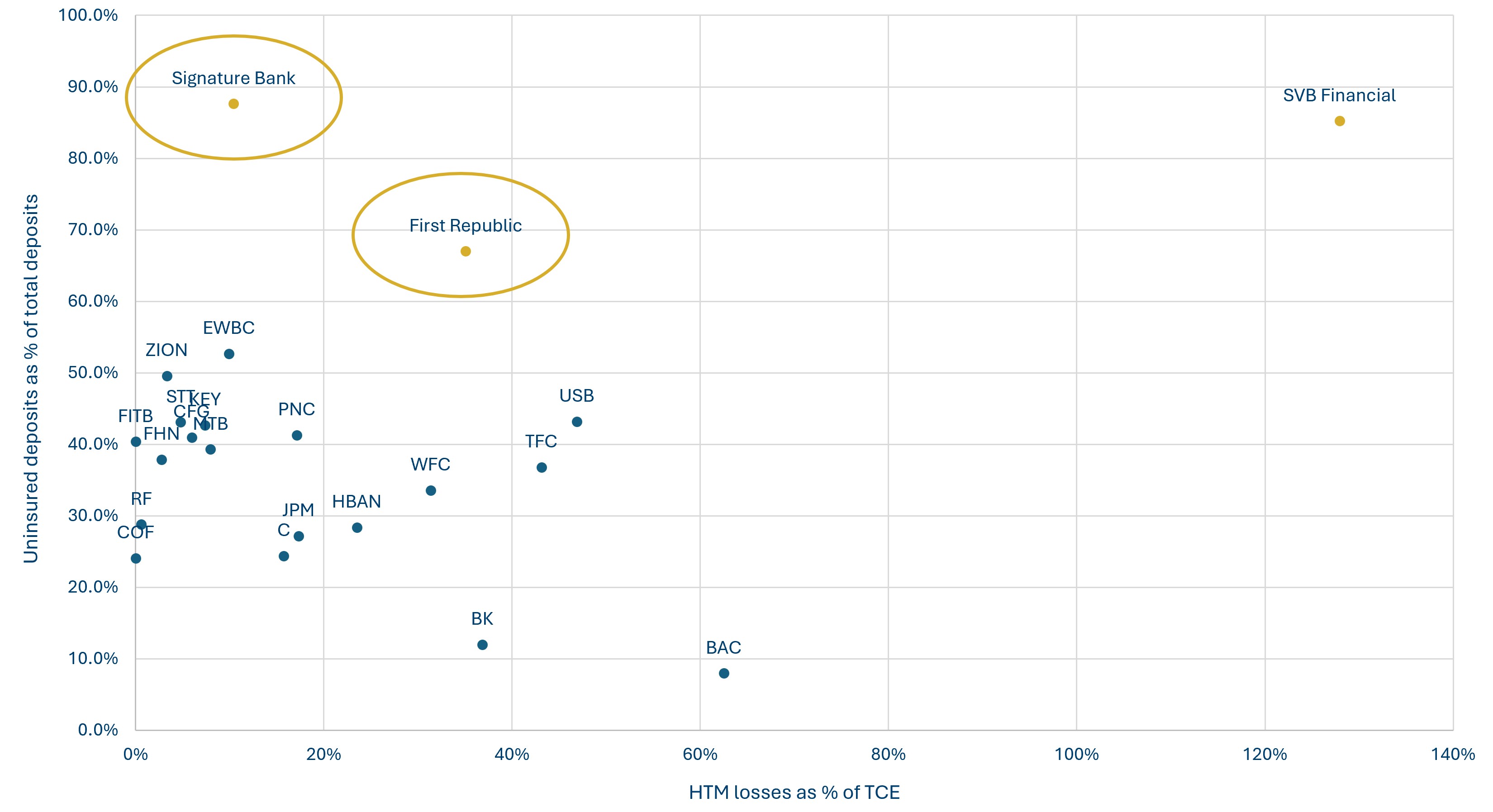 |
Source: Companies’ 10-K filing, FY22; as at March 2023. |
What followed was a reminder that markets, once spooked, quickly identify the weakest institution. Within days, Credit Suisse, already weakened by years of operational failures and reputational damage, found itself in the crosshairs.
Despite its very different business model and systemically important size and categorisation, it emerged as the weakest link in European banking. Its forced takeover by UBS over a single weekend resulted in the complete write-down of its AT1s.
The lesson is that vulnerabilities are often exposed faster than expected and rarely in the way investors anticipate.
Where we see risks today
In constructing our portfolio, we think carefully about avoiding exposure to institutions that carry the characteristics of the weakest in the pack. Three features concern us most at present.
1. Concentrated exposures
German commercial real estate (CRE) lenders are a clear example of concentrated exposures. Several smaller German banks, such as Deutsche Pfrandbriefbank (PBB) have loan books heavily weighted towards commercial real estate (offices; retail; logistics), built at valuations that have since fallen as interest rates rose, refinancing conditions tightened and structural shifts in working patterns weighed on office demand. These institutions remain solvent today but their capacity to absorb further stress is lower than more diversified peers. While that distinction is priced modestly in a calm market, it is treated more severely when markets become stressed.
2. Dependence on a single revenue stream
BFF Bank is a good example of dependence on a single revenue stream. Its model is built around factoring – purchasing receivables owed by public sector entities, primarily in Italy and other Southern European markets. It has historically been a profitable business, benefiting from the slow payment behaviour of public administrations. Its revenues, however, are not diversified across lending, fee income and treasury activity as would be the case for broader peers. As the Italian factoring market has faced regulatory change, BFF Bank has had limited ability to offset that pressure elsewhere.
Year-to-date equity and bond total return for PBB and BFF Bank
Source: Polar Capital, Bloomberg; 11 June 2026.
3. Hidden duration and liquidity risk
The third concern is less about what an institution lends and more about what it holds. Over the past decade, certain institutions, such as US life insurers, have meaningfully shifted their investment portfolios towards longer-duration assets and private credit in search of yield. The strategy made sense in a low interest rate environment: illiquid, complex assets offer a spread premium and long-duration liabilities appear well-matched by long-duration assets. In our view, this approach carries risks that are not always apparent until conditions change. Private credit, for example, can prove difficult to value accurately and harder still to sell in a stress scenario. While the underlying exposures may ultimately prove sound, in the short term opacity and illiquidity tend to be characteristics that markets penalise hardest when sentiment turns.
Aesop's fable reminds us that vulnerability often becomes apparent only when conditions change. Financial markets work the same way, which is why we aim to avoid being exposed to the weakest institutions in the pack.