
2026 is set to mark a decisive inflection point in the AI revolution. ChatGPT was officially launched by OpenAI in November 2022 and for the past three years AI has advanced at extraordinary speed. However, we believe this year represents something different and is likely to be the point at which the AI transformation moves from debate to inevitability.

The key to understanding this shift is discontinuous progress.

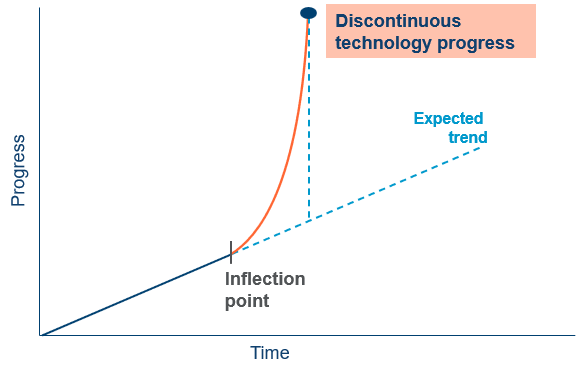
Most technological cycles evolve incrementally. Capability improves gradually, adoption builds steadily and markets adjust over time. AI is not following that pattern. We are in the midst of a rare period where capability compounds and inflects rather than advances at the margin. Decades of normal technological development are being compressed into years – as we saw with the printing press (and its huge structural impact on society), railway construction (new markets virtually overnight), mass production (the collapse in production costs) and the internet (became the default layer for information and commerce).

The nature of discontinuous progress
Discontinuous technology progress
Source: Polar Capital, August 2024. AI Impacts, 13 April 2020, https://aiimpacts.org/discontinuous-progress-in-history-an-update/.

Once this is understood, recent AI capital expenditure announcements make far more sense. Rapid advances in model capability, coding automation and capital investment are accelerating enterprise adoption to a scale that will be increasingly difficult for investors to ignore.

This is not a typical cycle.

Discontinuous progress drives inflection

Business adoption of generative AI is likely to materially accelerate in 2026. Judging by the progress demonstrated by Claude 4.5 and Gemini 3.0 at the end of 2025, coding automation appears to be approaching a structural tipping point. It may not be long before the majority of code is written by AI systems.

Commercial inflection is already visible in the data. Generative AI meets the criteria for one of these rare moments of discontinuity. It is both unpredictable and, in some quarters, still underappreciated. However, enterprise monetisation is scaling at an unprecedented rate.

OpenAI’s annual recurring revenue (ARR) was estimated at approximately $10bn in January 2025. By September 2025 it had risen to around $13bn and it surpassed $20bn for the full 2025 calendar year, confirmed in January 2026. That represents roughly 233% year-on-year growth.

We believe this year [2026] represents something different and is likely to be the point at which the AI transformation moves from debate to inevitability

Anthropic entered 2025 with an annualised revenue run rate of approximately $1bn. It accelerated to around $5bn by August, reached $9bn in December and, as of February 2026, has reportedly climbed to $14bn.

The progression from $10bn to over $20bn ARR at OpenAI, and from $1bn to $14bn at Anthropic within a single year, represents an extraordinary acceleration in enterprise AI monetisation. It is difficult to find historical parallels at this scale.

Capital markets are responding accordingly. Press reports suggest OpenAI is close to raising more than $100bn at a valuation that could exceed $850bn. Anthropic’s $30bn Series G funding round in early 2026 valued the company at approximately $380bn. Such capital intensity reflects conviction that AI capability and demand will continue to expand.

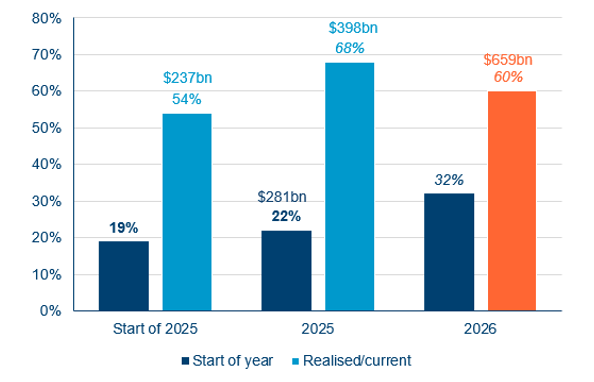
Consensus estimates for AI / hyperscale capex
Consensus Estimates For Ai Hyperscale Capex
Source: FactSet, Goldman Sachs Global Investment Research, AI Capex boom, 7 November 2025. Forecasts are based upon subjective estimates and assumptions about circumstances and events that may not yet have taken place and may never do so.

From debate to inevitability?

We expect AI model performance to continue improving. If that trajectory holds, 2026 is likely to mark a turning point for business adoption. It may prove to be the year when the widespread impact of AI becomes too obvious to ignore, with implications extending well beyond the technology sector.

AI spending today accounts for approximately 1% of global GDP. Historical precedent suggests this could rise to 2-5% at peak intensity, with the investment cycle lasting at least 5-10 years. If correct, the current phase remains early.

While valuations have expanded, performance over the past three years has largely been fundamentally driven, supported by robust AI capex growth. That stands in contrast to the late 1990s and the Covid period when strong returns were primarily driven by price and multiple expansion.

Risks remain. If AI model progress were to stall, investment momentum could slow. However, recent advances suggest scaling laws remain intact for now. As with all new technology cycles, volatility should be expected.

The more important point is structural. Discontinuous progress changes behaviour. It changes capital allocation. It changes competitive dynamics.

In our view, 2026 is likely to be remembered as the year that AI ceased to be a topic of discussion and became an inevitability.


Risks

  • Capital is at risk and there is no guarantee the Fund will achieve its objective. Investors should make sure their attitude towards risk is aligned with the risk profile of the Fund before investing.
  • Past performance is not a reliable guide to future performance. The value of investments may go down as well as up and you might get back less than you originally invested as there is no guarantee in place.
  • The value of a fund’s assets may be affected by uncertainties such as international political developments, market sentiment, economic conditions, changes in government policies, restrictions on foreign investment and currency repatriation, currency fluctuations and other developments in the laws and regulations of countries in which investment may be made. Please see the Fund’s Prospectus for details of all risks.
  • The Fund invests in the shares of companies and share prices can rise or fall due to several factors affecting global stock markets.
  • The Fund uses derivatives which carry the risk of reduced liquidity, substantial loss and increased volatility in adverse market conditions, such as failure amongst market participants.
  • The Fund invests in assets denominated in currencies other than the Fund's base currency. Changes in exchange rates may have a negative impact on the Fund's investments. If the share class currency is different from the currency of the country in which you reside, exchange rate fluctuations may affect your returns when converted into your local currency. Hedged share classes may have associated costs which may impact the performance of your investment.
  • The Fund invests in a relatively concentrated number of companies and industries based in one sector. This focused strategy can produce high gains but can also lead to significant losses. The Fund may be less diversified than other investment funds.
  • The Fund invests in emerging markets where there is a greater risk of volatility due to political and economic uncertainties, restrictions on foreign investment, currency repatriation and currency fluctuations. Developing markets are typically less liquid which may result in large price movements to the Fund.


Important Information:
 This is a marketing communication and does not constitute a solicitation or offer to any person to buy or sell and related securities or financial instruments. Any opinions expressed may change. This document does not contain information material to the investment objectives or financial needs of the recipient. This document is not advice on legal, taxation or investment matters. Tax treatment depends on personal circumstances. Investors must rely on their own examination of the fund or seek advice. Investment may be restricted in other countries and as such, any individual who receives this document must make themselves aware of their respective jurisdiction and observe any restrictions.

A decision may be taken at any time to terminate the marketing of the Fund in any EEA Member State in which it is currently marketed. Shareholders in the affected EEA Member State will be given notification of any decision and provided the opportunity to redeem their interests in the Fund, free of any charges or deductions, for at least 30 working days from the date of the notification.

Investment in the Fund concerns shares of the Fund and not in the underlying investments of the Fund. Further information about fund characteristics and any associated risks can be found in the Fund’s Key Information Document or Key Investor Information Document (“KID” or “KIID”), the Prospectus (and relevant Fund Supplement), the Articles of Association and the Annual and Semi-Annual Reports. Please refer to these documents before making any final investment decisions. These documents are available free of charge at Polar Capital Funds plc, Georges Court, 54-62 Townsend Street, Dublin 2, Ireland, via email by contacting Investor-Relations@polarcapitalfunds.com or at www.polarcapital.co.uk. The KID is available in the languages of all EEA member states in which the Fund is registered for sale; the Prospectus, Annual and Semi-Annual Reports and KIID are available in English.

The Fund promotes, among other characteristics, environmental or social characteristics and is classified as an Article 8 fund under the EU's Sustainable Finance Disclosure Regulation (SFDR). For more information, please see the Prospectus and relevant Fund Supplement.

ESG and sustainability characteristics are further detailed on the investment manager’s website: - https://www.polarcapital.co.uk/ESG-and-Sustainability/Responsible-Investing/.

A summary of investor rights associated with investment in the Fund can be found here.

This document is provided and approved by both Polar Capital LLP and Polar Capital (Europe) SAS.

Polar Capital LLP is authorised and regulated by the Financial Conduct Authority (“FCA”) in the United Kingdom, and the Securities and Exchange Commission (“SEC”) in the United States. Polar Capital LLP’s registered address is 16 Palace Street, London, SW1E 5JD, United Kingdom.

Polar Capital (Europe) SAS is authorised and regulated by the Autorité des marchés financiers (AMF) in France. Polar Capital (Europe) SAS’s registered address is 18 Rue de Londres, Paris 75009, France.

Polar Capital LLP is a registered Investment Advisor with the SEC. Polar Capital LLP is the investment manager and promoter of Polar Capital Funds plc – an open-ended investment company with variable capital and with segregated liability between its sub-funds – incorporated in Ireland, authorised by the Central Bank of Ireland and recognised by the FCA. FundRock Management Company (Ireland) Limited acts as management company and is regulated by the Central Bank of Ireland. Registered Address: Percy Exchange, 8/34 Percy Place, Dublin 4, Ireland.

For UK investors: The Fund is recognised in the UK under the Overseas Funds Regime (OFR) but it is not a UK-authorised Fund. UK investors should be aware that they may not be able to refer a complaint against its Management Company or its Depositary to the UK’s Financial Ombudsman Service. Any claims for losses relating to the Management Company or the Depositary will not be covered by the Financial Services Compensation Scheme, in the event that either entity should become unable to meet its liabilities to investors. For information on the complaint process to the Management Company, please see the Country Supplement for this fund available at https://www.polarcapital.co.uk/

Benchmark: The Fund is actively managed and uses the Dow Jones Global Technology Net Total Return Index as a performance target. The benchmark has been chosen as it is generally considered to be representative of the investment universe in which the Fund invests. The performance of the Fund is likely to differ from the performance of the benchmark as the holdings, weightings and asset allocation will be different. Investors should carefully consider these differences when making comparisons. Further information about the benchmark can be found here. The benchmark is provided by an administrator on the European Securities and Markets Authority (ESMA) register of benchmarks which includes details of all authorised, registered, recognised and endorsed EU and third country benchmark administrators together with their national competent authorities.

Third-party Data: Some information contained herein has been obtained from third party sources and has not been independently verified by Polar Capital. Neither Polar Capital nor any other party involved in or related to compiling, computing or creating the data makes any express or implied warranties or representations with respect to such data (or the results to be obtained by the use thereof), and all such parties hereby expressly disclaim all warranties of originality, accuracy, completeness, merchantability or fitness for a particular purpose with respect to any data contained herein.

Country Specific Disclaimers: Please be aware that not every share class of every fund is available in all jurisdictions. When considering an investment into the Fund, you should make yourself aware of the relevant financial, legal and tax implications. Neither Polar Capital LLP nor Polar Capital Funds plc shall be liable for, and accept no liability for, the use or misuse of this document.

None

2026 is set to mark a decisive inflection point in the AI revolution. ChatGPT was officially launched by OpenAI in November 2022 and for the past three years AI has advanced at extraordinary speed. However, we believe this year represents something different and is likely to be the point at which the AI transformation moves from debate to inevitability.

The key to understanding this shift is discontinuous progress.

Most technological cycles evolve incrementally. Capability improves gradually, adoption builds steadily and markets adjust over time. AI is not following that pattern. We are in the midst of a rare period where capability compounds and inflects rather than advances at the margin. Decades of normal technological development are being compressed into years – as we saw with the printing press (and its huge structural impact on society), railway construction (new markets virtually overnight), mass production (the collapse in production costs) and the internet (became the default layer for information and commerce).

The nature of discontinuous progress
Discontinuous technology progress
Source: Polar Capital, August 2024. AI Impacts, 13 April 2020, https://aiimpacts.org/discontinuous-progress-in-history-an-update/.

Once this is understood, recent AI capital expenditure announcements make far more sense. Rapid advances in model capability, coding automation and capital investment are accelerating enterprise adoption to a scale that will be increasingly difficult for investors to ignore.

This is not a typical cycle.

Discontinuous progress drives inflection

Business adoption of generative AI is likely to materially accelerate in 2026. Judging by the progress demonstrated by Claude 4.5 and Gemini 3.0 at the end of 2025, coding automation appears to be approaching a structural tipping point. It may not be long before the majority of code is written by AI systems.

Commercial inflection is already visible in the data. Generative AI meets the criteria for one of these rare moments of discontinuity. It is both unpredictable and, in some quarters, still underappreciated. However, enterprise monetisation is scaling at an unprecedented rate.

OpenAI’s annual recurring revenue (ARR) was estimated at approximately $10bn in January 2025. By September 2025 it had risen to around $13bn and it surpassed $20bn for the full 2025 calendar year, confirmed in January 2026. That represents roughly 233% year-on-year growth.

We believe this year [2026] represents something different and is likely to be the point at which the AI transformation moves from debate to inevitability

Anthropic entered 2025 with an annualised revenue run rate of approximately $1bn. It accelerated to around $5bn by August, reached $9bn in December and, as of February 2026, has reportedly climbed to $14bn.

The progression from $10bn to over $20bn ARR at OpenAI, and from $1bn to $14bn at Anthropic within a single year, represents an extraordinary acceleration in enterprise AI monetisation. It is difficult to find historical parallels at this scale.

Capital markets are responding accordingly. Press reports suggest OpenAI is close to raising more than $100bn at a valuation that could exceed $850bn. Anthropic’s $30bn Series G funding round in early 2026 valued the company at approximately $380bn. Such capital intensity reflects conviction that AI capability and demand will continue to expand.

Consensus estimates for AI / hyperscale capex
Consensus Estimates For Ai Hyperscale Capex
Source: FactSet, Goldman Sachs Global Investment Research, AI Capex boom, 7 November 2025. Forecasts are based upon subjective estimates and assumptions about circumstances and events that may not yet have taken place and may never do so.

From debate to inevitability?

We expect AI model performance to continue improving. If that trajectory holds, 2026 is likely to mark a turning point for business adoption. It may prove to be the year when the widespread impact of AI becomes too obvious to ignore, with implications extending well beyond the technology sector.

AI spending today accounts for approximately 1% of global GDP. Historical precedent suggests this could rise to 2-5% at peak intensity, with the investment cycle lasting at least 5-10 years. If correct, the current phase remains early.

While valuations have expanded, performance over the past three years has largely been fundamentally driven, supported by robust AI capex growth. That stands in contrast to the late 1990s and the Covid period when strong returns were primarily driven by price and multiple expansion.

Risks remain. If AI model progress were to stall, investment momentum could slow. However, recent advances suggest scaling laws remain intact for now. As with all new technology cycles, volatility should be expected.

The more important point is structural. Discontinuous progress changes behaviour. It changes capital allocation. It changes competitive dynamics.

In our view, 2026 is likely to be remembered as the year that AI ceased to be a topic of discussion and became an inevitability.
Related Fund

Risks

  • Capital is at risk and there is no guarantee the Fund will achieve its objective. Investors should make sure their attitude towards risk is aligned with the risk profile of the Fund before investing.
  • Past performance is not a reliable guide to future performance. The value of investments may go down as well as up and you might get back less than you originally invested as there is no guarantee in place.
  • The value of a fund’s assets may be affected by uncertainties such as international political developments, market sentiment, economic conditions, changes in government policies, restrictions on foreign investment and currency repatriation, currency fluctuations and other developments in the laws and regulations of countries in which investment may be made. Please see the Fund’s Prospectus for details of all risks.
  • The Fund invests in the shares of companies and share prices can rise or fall due to several factors affecting global stock markets.
  • The Fund uses derivatives which carry the risk of reduced liquidity, substantial loss and increased volatility in adverse market conditions, such as failure amongst market participants.
  • The Fund invests in assets denominated in currencies other than the Fund's base currency. Changes in exchange rates may have a negative impact on the Fund's investments. If the share class currency is different from the currency of the country in which you reside, exchange rate fluctuations may affect your returns when converted into your local currency. Hedged share classes may have associated costs which may impact the performance of your investment.
  • The Fund invests in a relatively concentrated number of companies and industries based in one sector. This focused strategy can produce high gains but can also lead to significant losses. The Fund may be less diversified than other investment funds.
  • The Fund invests in emerging markets where there is a greater risk of volatility due to political and economic uncertainties, restrictions on foreign investment, currency repatriation and currency fluctuations. Developing markets are typically less liquid which may result in large price movements to the Fund.


Important Information:
 This is a marketing communication and does not constitute a solicitation or offer to any person to buy or sell and related securities or financial instruments. Any opinions expressed may change. This document does not contain information material to the investment objectives or financial needs of the recipient. This document is not advice on legal, taxation or investment matters. Tax treatment depends on personal circumstances. Investors must rely on their own examination of the fund or seek advice. Investment may be restricted in other countries and as such, any individual who receives this document must make themselves aware of their respective jurisdiction and observe any restrictions.

A decision may be taken at any time to terminate the marketing of the Fund in any EEA Member State in which it is currently marketed. Shareholders in the affected EEA Member State will be given notification of any decision and provided the opportunity to redeem their interests in the Fund, free of any charges or deductions, for at least 30 working days from the date of the notification.

Investment in the Fund concerns shares of the Fund and not in the underlying investments of the Fund. Further information about fund characteristics and any associated risks can be found in the Fund’s Key Information Document or Key Investor Information Document (“KID” or “KIID”), the Prospectus (and relevant Fund Supplement), the Articles of Association and the Annual and Semi-Annual Reports. Please refer to these documents before making any final investment decisions. These documents are available free of charge at Polar Capital Funds plc, Georges Court, 54-62 Townsend Street, Dublin 2, Ireland, via email by contacting Investor-Relations@polarcapitalfunds.com or at www.polarcapital.co.uk. The KID is available in the languages of all EEA member states in which the Fund is registered for sale; the Prospectus, Annual and Semi-Annual Reports and KIID are available in English.

The Fund promotes, among other characteristics, environmental or social characteristics and is classified as an Article 8 fund under the EU's Sustainable Finance Disclosure Regulation (SFDR). For more information, please see the Prospectus and relevant Fund Supplement.

ESG and sustainability characteristics are further detailed on the investment manager’s website: - https://www.polarcapital.co.uk/ESG-and-Sustainability/Responsible-Investing/.

A summary of investor rights associated with investment in the Fund can be found here.

This document is provided and approved by both Polar Capital LLP and Polar Capital (Europe) SAS.

Polar Capital LLP is authorised and regulated by the Financial Conduct Authority (“FCA”) in the United Kingdom, and the Securities and Exchange Commission (“SEC”) in the United States. Polar Capital LLP’s registered address is 16 Palace Street, London, SW1E 5JD, United Kingdom.

Polar Capital (Europe) SAS is authorised and regulated by the Autorité des marchés financiers (AMF) in France. Polar Capital (Europe) SAS’s registered address is 18 Rue de Londres, Paris 75009, France.

Polar Capital LLP is a registered Investment Advisor with the SEC. Polar Capital LLP is the investment manager and promoter of Polar Capital Funds plc – an open-ended investment company with variable capital and with segregated liability between its sub-funds – incorporated in Ireland, authorised by the Central Bank of Ireland and recognised by the FCA. FundRock Management Company (Ireland) Limited acts as management company and is regulated by the Central Bank of Ireland. Registered Address: Percy Exchange, 8/34 Percy Place, Dublin 4, Ireland.

For UK investors: The Fund is recognised in the UK under the Overseas Funds Regime (OFR) but it is not a UK-authorised Fund. UK investors should be aware that they may not be able to refer a complaint against its Management Company or its Depositary to the UK’s Financial Ombudsman Service. Any claims for losses relating to the Management Company or the Depositary will not be covered by the Financial Services Compensation Scheme, in the event that either entity should become unable to meet its liabilities to investors. For information on the complaint process to the Management Company, please see the Country Supplement for this fund available at https://www.polarcapital.co.uk/

Benchmark: The Fund is actively managed and uses the Dow Jones Global Technology Net Total Return Index as a performance target. The benchmark has been chosen as it is generally considered to be representative of the investment universe in which the Fund invests. The performance of the Fund is likely to differ from the performance of the benchmark as the holdings, weightings and asset allocation will be different. Investors should carefully consider these differences when making comparisons. Further information about the benchmark can be found here. The benchmark is provided by an administrator on the European Securities and Markets Authority (ESMA) register of benchmarks which includes details of all authorised, registered, recognised and endorsed EU and third country benchmark administrators together with their national competent authorities.

Third-party Data: Some information contained herein has been obtained from third party sources and has not been independently verified by Polar Capital. Neither Polar Capital nor any other party involved in or related to compiling, computing or creating the data makes any express or implied warranties or representations with respect to such data (or the results to be obtained by the use thereof), and all such parties hereby expressly disclaim all warranties of originality, accuracy, completeness, merchantability or fitness for a particular purpose with respect to any data contained herein.

Country Specific Disclaimers: Please be aware that not every share class of every fund is available in all jurisdictions. When considering an investment into the Fund, you should make yourself aware of the relevant financial, legal and tax implications. Neither Polar Capital LLP nor Polar Capital Funds plc shall be liable for, and accept no liability for, the use or misuse of this document.