


Implications of NVIDIA earnings and AI outlook

NVIDIA posted a very strong quarter, growing +85% year on year (y/y) and printing its fourth consecutive quarter of y/y growth acceleration while maintaining c75% gross margins.
The company also announced an $80bn buyback and a dividend hike from one cent to 25 cents per share, with capital returns to shareholders now becoming a more significant part of the investment case. NVIDIA is expected to generate c$400-500bn of free cashflow over the next 2-3 years. CEO Jensen Huang was notably vocal on the company’s recent earnings call about taking share in frontier labs – a key data point in our view.
The Q2 guide also exceeded expectations at $91bn, representing c95% y/y growth and a fifth consecutive quarter of accelerating growth. The next-generation Vera Rubin platform remains on track, with production in Q3 and the bulk of the ramp expected in Q4.
In short, this was a strong earnings report and a strong guide. It supports our pro-AI and constructive positioning for the Polar Capital Global Technology Fund.
No signs of AI infrastructure buildout slowing
AI demand clearly remains robust, while the gap between supply and demand remains wide. NVIDIA remains a top holding in the Fund (though underweight given UCITS constraints) and we expect it to continue grinding higher over the year as supply constraints ease, estimates move up and buybacks provide additional support.
The Google I/O 2026 keynote this week provided some of the most compelling third-party validation yet of the acceleration in AI adoption and inference demand. Google is now processing 3.2 quadrillion tokens per month, up from 480 trillion a year ago and just 9.7 trillion two years ago. This is a 330x increase in two years and a 7x increase in the past 12 months alone, driven in part by the shift to reasoning models, which consume significantly more tokens per interaction. The Gemini app has now surpassed 900 million monthly active users, more than doubling from 400 million a year ago.
These figures are not Google-specific phenomena – they speak to a broader and accelerating step-change in the velocity of AI consumption globally and directly support our view that inference demand is being structurally underestimated by the market.
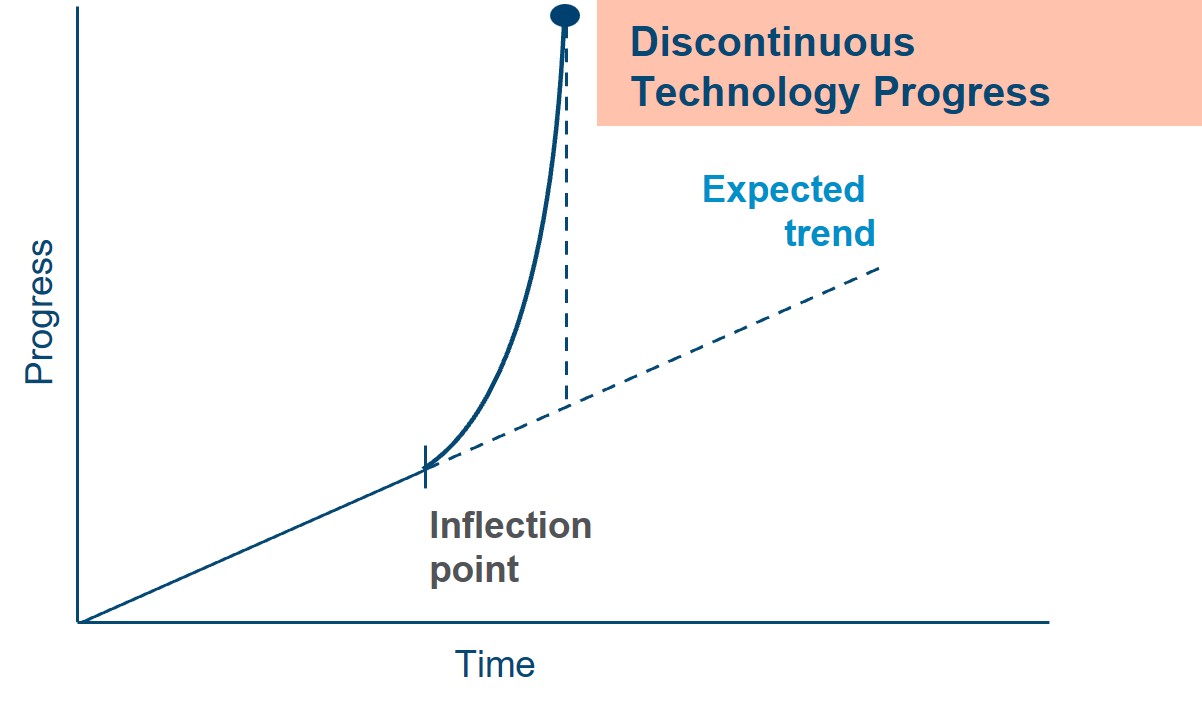
The nature of discontinuous progress |
|
Source: AI Impacts , 13 April 2020 |
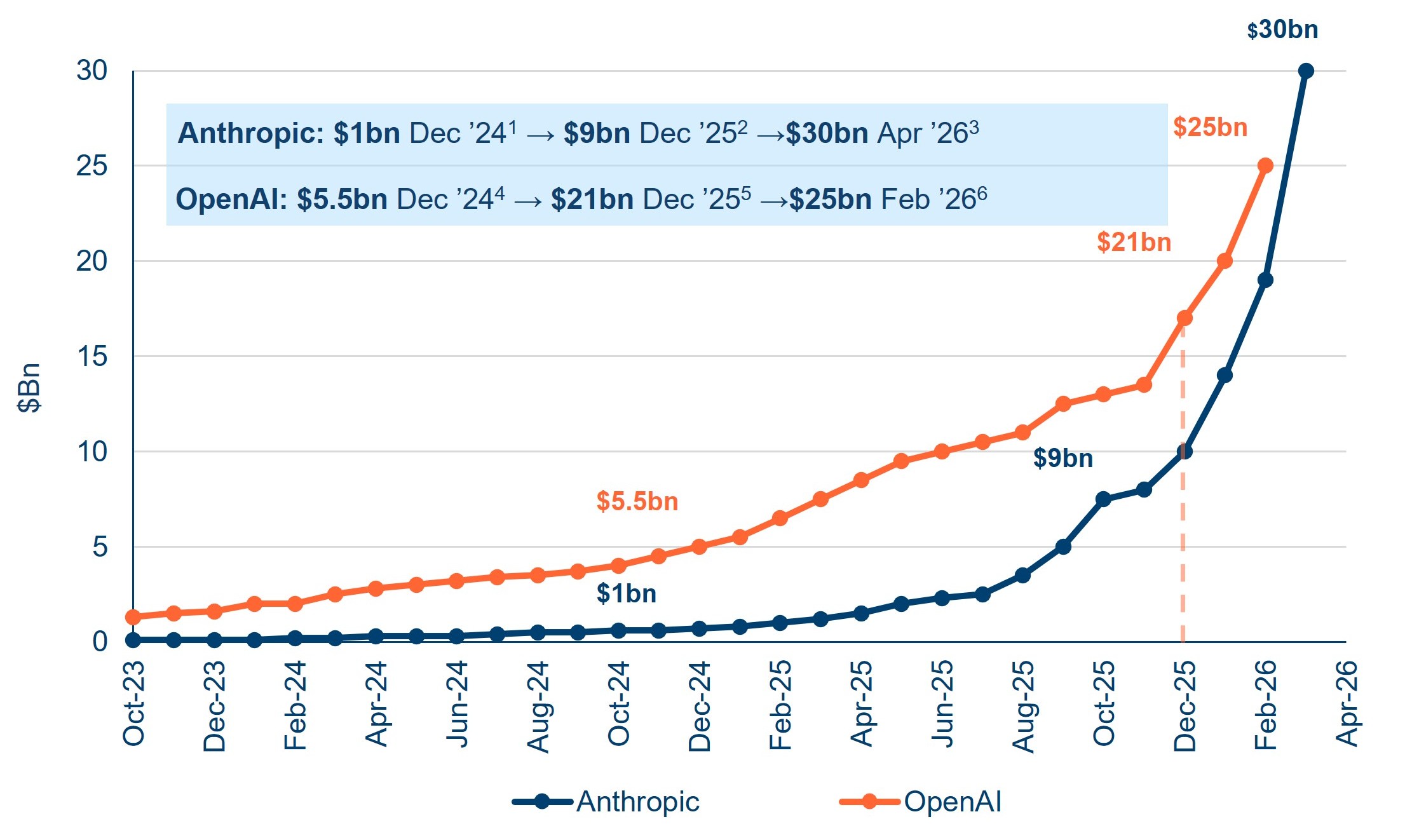
Anthropic & OpenAI – Annual Recurring Revenue (ARR) Run Rate |
|
Source: 1. SaaStr, December 2024. 2. Sherwood News, October 2025. 3. Bloomberg March 2026. 4. Reuters, October 2025. 5. OpenAI, January 2026. 6. Reuters, March 2026. |
Early in – and positioned for – the AI Cycle
Looking at the sector more broadly, a strong set of Q1 earnings and robust guidance has driven stocks higher as estimates have been revised upwards. Enterprise AI demand has clearly inflected in the past 4-6 months, driven by agentic AI and recent model progress. It is our view that while supply constraints exist for now, as capacity grows true demand will become more visible through H2 2026.
We have been travelling extensively. This week we were in the US at the JP Morgan TMT Conference, meeting many of the key supply-chain stocks in the AI food chain. Meetings with Intel, Sandisk, Micron Technology, SoftBank Group, ARM Holdings, Seagate Technology, Western Digital, Coherent, Fabrinet, Flex, Corning, Infineon Technologies, ASML Holding and GE Vernova were all reassuring on AI demand with a continued constructive outlook. As such, in the near term we have limited fundamental concerns outside the considerable geopolitical and associated macro uncertainty.
That said, after strong year-to-date performance for many holdings – and absent a US/Iran peace deal – we may experience a healthy pause or period of sideways consolidation with ongoing volatility linked to geopolitics.
Over the longer term, we continue to believe AI demand is being understated as investors underestimate the impact of agentic AI
We have not made any material change to the Fund’s core pro-AI positioning, which we view as still early in a multi-year structural growth cycle. At a tactical level, however, we have been actively managing risk around the margins: profits have been taken in select names following a strong run, Fund beta has been modestly reduced in the near term and additional Nasdaq put options (June/July expiry; 6-12% out of the money) have been added to manage downside exposure while remaining fully invested in long-term themes.
In the meantime, we have used some of the proceeds to rebuild cybersecurity exposure over the past week, a move informed by company meetings and the emergence of Anthropic’s latest model as a catalyst for renewed focus on AI-driven cyber risk, a theme echoed by Ravi Kumar, Cognizant CEO, and highlighted by Cisco at its recent keynote presentation at the JP Morgan TMT Conference.
Not all profits have been redeployed, leaving a tactically elevated cash position to reduce Fund beta slightly in the near term, reflecting caution around geopolitical risks. If progress on a US/Iran deal is made, or stocks pull back further, liquidity is likely to be deployed given the robust fundamental outlook.
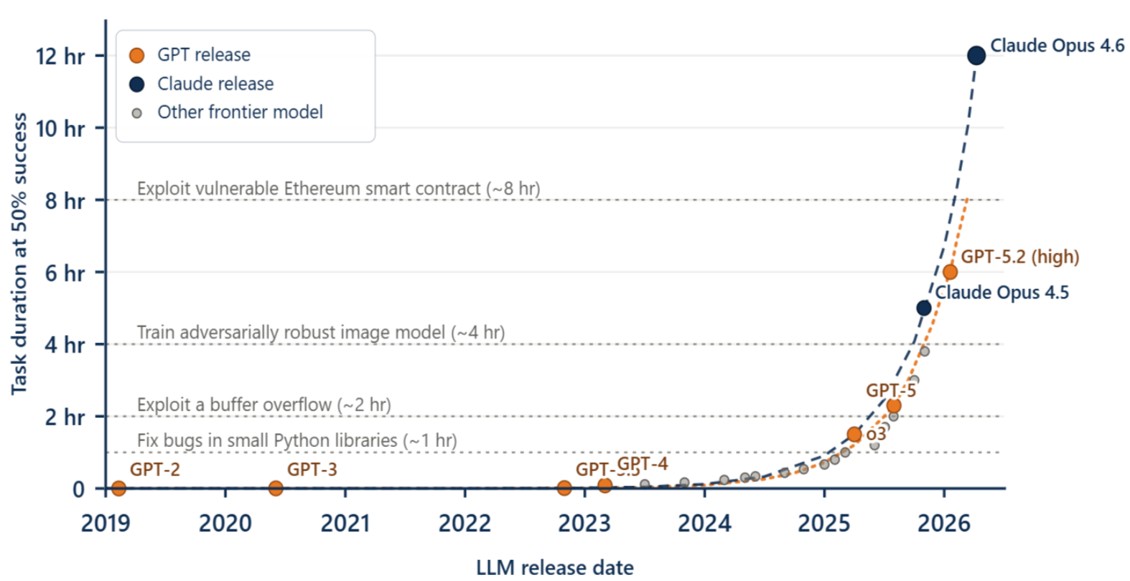
Over the longer term, we continue to believe AI demand is being understated as investors underestimate the impact of agentic AI and struggle to forecast the implications of discontinuous technological progress – decades of innovation compressed into years. The Google I/O token data is perhaps the clearest illustration of this: the trajectory from trillions to quadrillions is not a linear extrapolation but a step-change driven by the compounding effects of better models, wider distribution and agentic workflows multiplying token consumption per task.
Time horizon of software tasks different LLMs complete 50% of the time |
|
Source: METR, April 2026, Task-Completion Time Horizons of Frontier AI Models - METR |
New model releases should further support investor AI sentiment, with the wider release of Mythos and forthcoming models from leading labs. A successful SpaceX IPO may also ignite broader investor interest.