


Having adopted an ‘AI maximalist’ approach almost three years ago, it is not a surprise to us to see the Magnificent Seven (Mag7) stocks lagging and Software and Information Services stocks struggling so far this year. We believe this is best understood as a continuation of trends that began to establish themselves last year and was one of the drivers of our strong performance in 2025 as we reallocated capital away from each group to capture a broadening of participation across both AI enablers and beneficiaries.
Prior to 2025, most of the Mag7, as well as Software and Information Services stocks, were perceived to be AI beneficiaries. However, the future has become less certain with credible two-way debates emerging for many stocks, creating uncertainty over the terminal values of these businesses. As such, we believe they are likely to remain less good conduits for AI progress for now.
| Fund Performance vs. Indices |
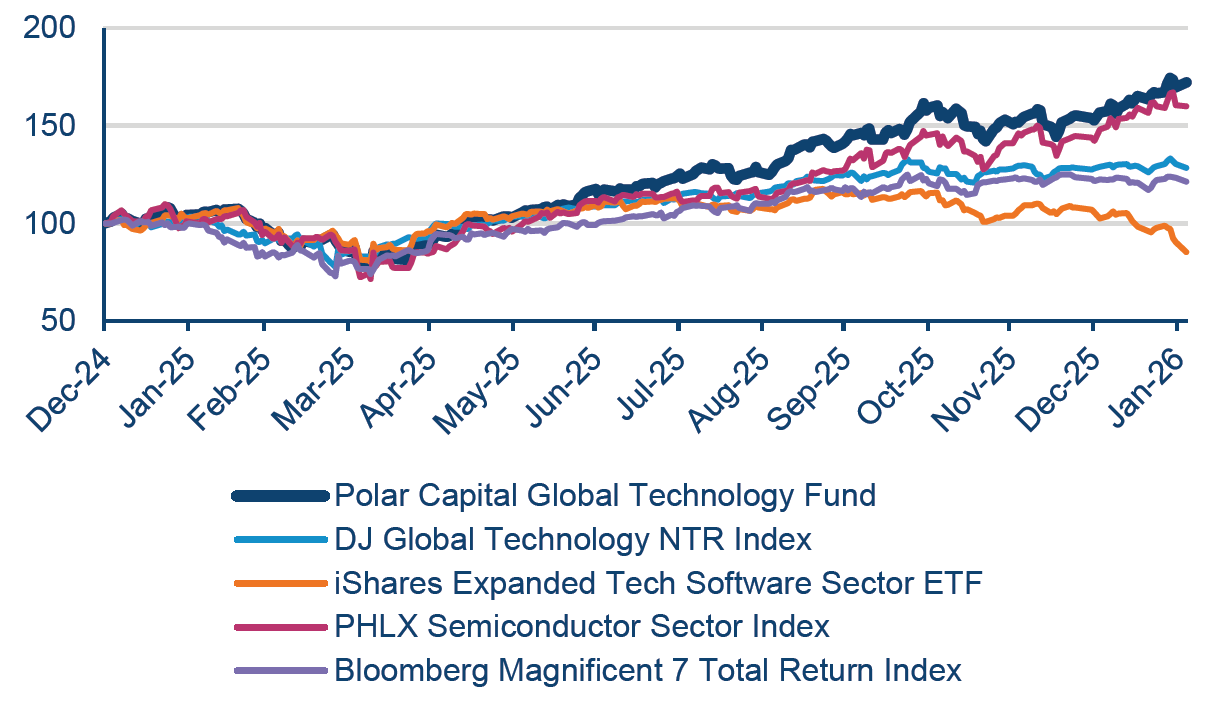 |
| Source: Bloomberg 4 February 2026. Performance is representative of the USD Class I Dist share class which launched on 4 September 2009. All figures in USD terms. |
With capital intensity increasing, the market is likely to become more focused on the returns generated by AI investment, rewarding those able to demonstrate strong returns and potentially punishing those unable to do so. This perhaps explains the negative reaction to the recent Microsoft results, which saw AI capex surprise to the upside, but Azure growth did not, suggesting that at least some of its AI spending may be defensive in nature (necessary to sustain the core Office franchise?). In contrast, Meta Platforms also increased AI spending but this was accompanied by robust results and an upbeat tone regarding AI returns as well as progress on its new AI model. Differences aside, we have continued to reduce our overall exposure to Mag7, although our allocations remain dynamic and we can use call options to partially mitigate the risks of being underweight.
| Fund vs Benchmark: Mag7 - Actual & Active Exposure |
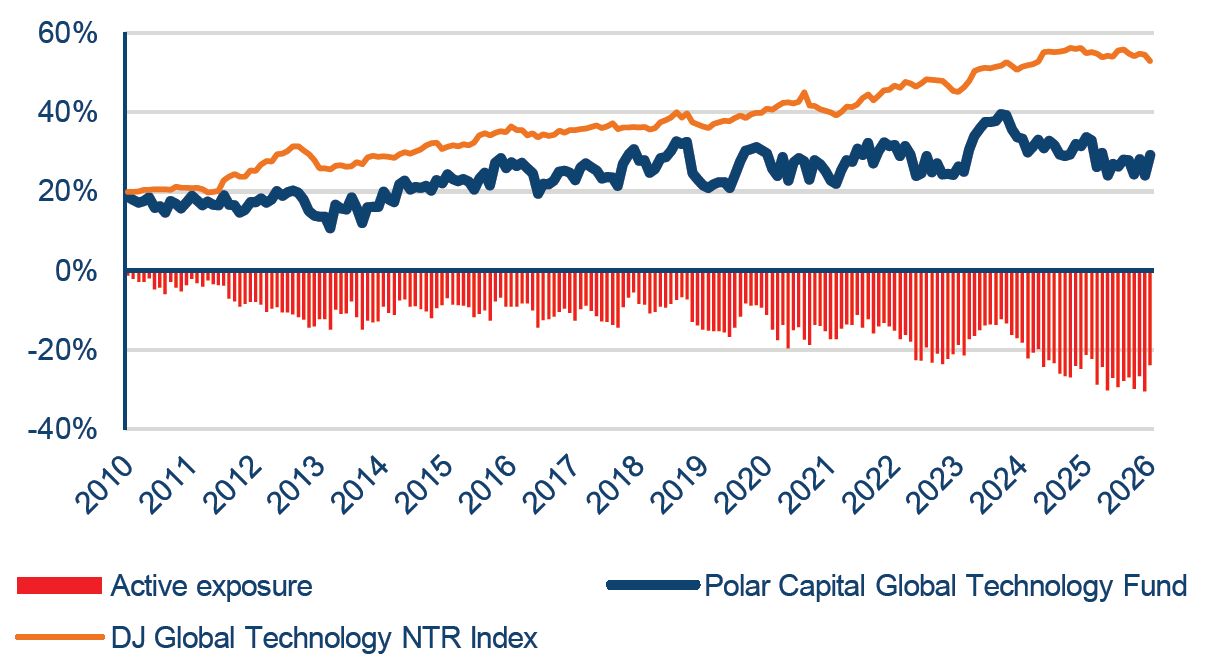 |
| Source: Polar Capital, Bloomberg, 5 February 2026. |
How the Fund is positioned
Application software: The commoditisation of code and the growing role of AI as an alternative solution to managing and accessing data has created a significant overhang over terminal values. Across our fund range, our software exposure is at its lowest in more than a decade. In the Polar Capital Global Technology Fund, software accounts for less than 7% compared to a more traditional exposure in the past of c20-25%. Application software exposure is now negligible.
Infrastructure/security software: Although we have reduced exposure here too, especially in cybersecurity (due to an evolving threat landscape), we still hold a limited number of smaller positions in infrastructure software companies. AI should drive more code, more applications and more data, which should result in the need to store and analyse a great deal more data including more telemetry for ongoing training/ improvement purposes (the feedback loop). These are typically usage-based models which should benefit from any volume explosion, although this stack will likely evolve with new AI-centric competitors or self-built solutions from hyperscalers with less human involvement. We are watching individual stocks closely.
Information services: Information services appears to be right in the crosshairs of AI disruption, as new coworking tools from OpenAI and Anthropic appear increasingly competitive, with incumbent solutions and the scope and defensibility of proprietary data being challenged. Just a few years ago, data assets were considered a key advantage in an AI world, but the advent of better reasoning models able to interpolate is challenging that earlier assumption. Gartner, RELX, FactSet and Wolters Kluwer are some of the best managed in their industries, but AI progress and nascent AI competition are questioning the value of their competitive moats and their terminal values in an AI-centric world.
| Fund vs Benchmark: Software - Actual & Active Exposure |
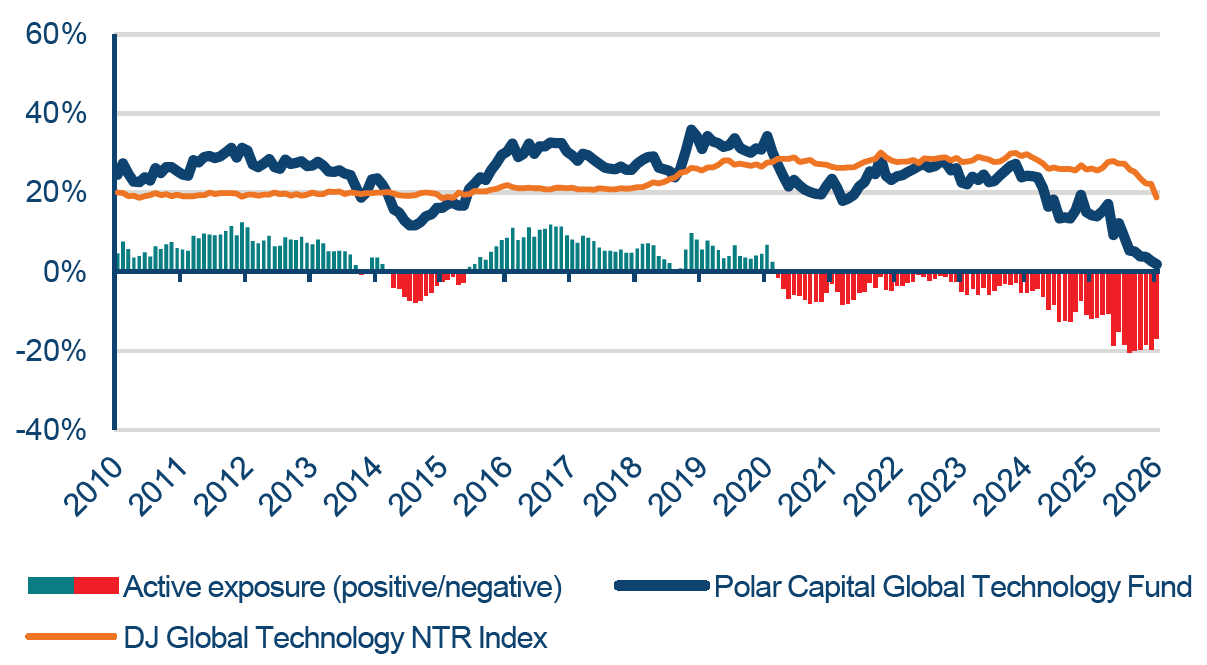 |
| Source: Polar Capital, Bloomberg, 5 February 2026. |
To us, this is following the classic pattern of technology disruption. Three years in, we are moving into the next phase of the AI cycle: initially inferior technologies (GPT-3.5) appear complementary to existing solutions (app software) but as AI models have improved so rapidly they are becoming substitutes. This dynamic challenges the value of incumbency and forces existing players to more fully embrace AI, which we believe is best understood as a defensive investment.
Improved AI model performance
Recent weakness in companies perceived to be at risk also reflects improved AI model performance. In 4Q25 Google Gemini 3.0 and Anthropic Claude 4.5 launched to strong reviews, with both delivering a notable improvement in performance, reduced hallucinations and, in the case of Claude Code, a breakthrough in coding capability. We expect this rapid pace of innovation to continue in 2026.
There have been several other linked developments that highlight the rapid progress.
- Claude Cowork (Anthropic): an agentic desktop tool for knowledge workers; can be used to create entire code bases, run tests and fix bugs autonomously
- Clawdbot (now Moltbot): an open-source agent that runs on edge devices (e.g. Mac mini) and connects large language models (LLMs) to your personal productivity tools to do tasks for you
- Google Genie: highlighted the possible impact of world models and potential to generate probabilistic tools rather than deterministic code (impacting video game stocks)
- Claude Cowork legal plugin: showed expanded capabilities in a complex legal environment, bridging the gap from model to workflow (the role of app software)
Why does this matter?
AI capable of writing code has changed the cost of creating software – built on code – which, all things being equal, means incumbents are likely to face intensifying competition from existing competitors, AI-natives as well as internal IT efforts. You can see it in the app store already, with an explosion in app creation as vibe coding takes off.
We should also highlight a number of comments made so far during Q4 earnings season that have highlighted recent AI progress. These include:
Shopify CEO: “I shipped more code in the last three weeks than the decade before. The top AI models/agentic systems right now are an entirely different thing to what people used until the beginning of December.”
Mark Zuckerberg (Meta Platforms CEO): “[We are] starting to see projects that used to require big teams now be accomplished by a single, very talented person”.
Palantir CEO: “Not only are we getting rid of third-party software, but we’ve also replaced their functionality and then beaten them to new features”.
The end of the ‘Information Age’
In the Information Age, value was created by accessing, organising and processing data. In the most optimistic scenario, leading software companies successfully invest aggressively in AI capabilities to reinvent their products to address growing competitive threats. Even if they succeed, this still leaves business model challenges – in particular a likely shift to outcome base pricing rather than seat-based recurring revenue seen in SaaS (Software as a Service) companies.
At a minimum, AI investment is diverting IT budget away from enterprise software. Anthropic’s ARR (annual recurring revenue) has grown from $1bn in 2024 to $9bn in 2025 and it is targeting $26bn in 2026. Given it is largely enterprise focused, this would make the company the fastest growing enterprise software or 'intelligence' company at scale ever seen before. ServiceNow, a leading enterprise software provider, estimates $16bn in 2026 revenue growing 20% by comparison.
The beginning of the ‘Cognition Era’
The reason we are more cautious than many regarding software exposure is the belief we are moving into the Cognition Era, where value is created by synthesising, reasoning and acting on data. For traditional software and data service companies, this shift is dangerous because it rapidly depreciates their primary assets: proprietary code bases and gate-kept information.
In the Cognition Era, the software itself is no longer the product; the intelligence it delivers is the product. Companies selling ‘tools for humans’ will lose to companies selling ‘agents that do the work’. In the Information Age, digital disruptors packaged and delivered information to humans, while In the Cognition Era, cognition rather than information is the new barrier.
Over the coming months, we expect to write more about the Cognition Era as we see it and how it may impact us. However, for now we include a few preliminary thoughts about why the commoditisation of coding matters.
1. The commoditisation of coding
As AI makes software development cheaper, the barriers to entry drop. Micro-SaaS competitors can spring up overnight, cloning features of established giants at a fraction of the cost, driving prices down across the industry. Historically, if you built a complex piece of software, it was hard for competitors to copy because coding was slow and expensive. Your ‘moat’ is no longer your code; it is your brand, user trust and unique data – only unique data matters, publicly available data can be easily replicated.
2. Move to outcome-based pricing
The SaaS business model has been the gold standard for two decades. It relies on selling seats (subscriptions) to humans who use tools to do work. AI reduces the number of humans needed to do a task. In the Cognition Era, customers do not want to pay for access to a tool; they want to pay for the outcome.
3. Disruption of data services
Data service companies traditionally thrived by collecting, cleaning and selling access to information (e.g. Gartner, FactSet, Bloomberg and Nielsen or specialised market researchers). In the Information Age, users paid for raw data tables to analyse themselves. In the Cognition Era, AI models can ingest vast amounts of unstructured public data to approximate those same insights, bypassing the need for expensive, structured proprietary datasets.
4. Disintermediation of platforms/databases
Platforms that functioned as knowledge intermediaries, like Chegg for homework or Stack Overflow for coding solutions, are being bypassed. Users no longer need to search a database for an answer; they ask an AI agent to generate the answer. The value of the ‘search engine’ model collapses when the ‘reasoning engine’ arrives.
5. Agentic disruption to the user interface layer
Agentic capabilities are advancing rapidly. Meanwhile many companies are working on new AI interface devices (pins; badges; glasses). While it is early yet, we may be entering the end of the software interface as multi-modal AI removes the need for traditional interactions with data. Software is just a way for humans to store, analyse and interact with data; machines do not need that user interface layer.
Our conclusions
We have long believed that only companies that own a frontier AI model are likely to control their own destiny – a view we believe is shared by many of the biggest AI spenders today, many of whom also enjoy the best vantage point on AI progress (e.g. Alphabet, OpenAI, Anthropic, xAI and the hyperscalers, all of which are spending aggressively on AI capex). They are locked in a battle for model supremacy and/or survival.
Meanwhile, those who rely on third-party models are best understood as passengers or spectators in future AI progress. Even close partnerships may not be enough, especially as we move close to artificial general intelligence (AGI) where AI capabilities exceed those of humans – the Microsoft/OpenAI relationship is a good example. The best software and information services companies may navigate this period successfully and reinvent themselves, but history suggests the intervening period is usually uncomfortable.
For now, our focus remains building a diversified portfolio of the broader enablers of the Cognition Era, including broader data centre infrastructure, and beneficiaries. Our Polar Capital Artificial Intelligence Fund includes the much broader beneficiaries across all industries (being careful to ensure their advantage is not linked to data that can easily be replicated by AI). As Meta Platforms put it during its earnings call: “2026 is going to be the year that AI starts to dramatically change the way that we work”.