
The Polar Capital Sustainable Thematic Equity team project that electricity is set to rise from 20% of global energy use today to nearly 60% by 2050. In this Q&A Thiemo Lang, Senior Portfolio Manager of the Polar Capital Smart Energy Fund, explores how the portfolio is positioned to capitalise on this long-term structural trend. Thiemo also offers some reflections as the Fund approaches its five-year anniversary later this year and gives his outlook for the next five.

Q1: Decarbonisation is a long-term trend. What are the main drivers and what are currently the biggest challenges? What impact can shorter-term policy or geopolitics have on the trend and your portfolio?

A: Decarbonisation has been driven by initiatives worldwide aiming to reduce carbon emissions through moving to carbon-free power generation and implementing energy efficiency measures. Decarbonisation and the electrification of end markets are closely interlinked. Shorter-term policy and geopolitical developments can create volatility, particularly in areas such as subsidy regimes, trade restrictions or supply chains for critical materials. However, the Fund is constructed to focus on solution providers rather than policy-dependent outcomes. Many of our holdings benefit from electrification, efficiency and infrastructure investment regardless of the precise pace or direction of individual policy measures. This is especially evident with the recent surge in demand driven by AI data centres. Geopolitical uncertainty generally strengthens the argument for energy security, grid resilience and localised supply chains, all of which align with the Fund’s core investment themes.

Q2: From an investor’s perspective, what are the most interesting investment opportunities in Smart Energy?

A: The most compelling opportunities today sit at the intersection of rapidly rising electricity demand and structural bottlenecks in the system. This dynamic is particularly apparent in AI infrastructure, where data centre operators are increasingly constrained by the speed at which new power connections can be secured. Grid constraints, delays in getting permits, the intermittency of renewables and shortages in key electrical equipment such as transformers, switchgear and cables have become blockages. This is accelerating investment not only in grids, but also in behind-the-meter solutions such as onsite generation and large-scale battery systems that allow operators to manage peak loads and secure faster project timelines.

Over the next few years, access to reliable and sufficient power rather than computing hardware is expected to become the primary bottleneck for AI deployment. The current rush to build out data centres is shifting gears: from “time to power” to a mission for maximum efficiency. Due to grid transmission inefficiencies, power conversion losses, and the rigorous cooling needs of liquid-cooled chips, the total electricity required at the source is approximately twice the amount used for actual computation. This is driving strong demand for energy-efficient electrical infrastructure, transformers, power semiconductors, power supplies and cooling systems – all areas where the Fund has significant exposure.

Besides the investments linked to the build-out of IT power infrastructure, the “electrification of everything” trend encompasses a wide range of opportunities across the transportation, building and industrial sectors.

Besides the investments linked to the build-out of IT power infrastructure, the “electrification of everything” trend encompasses a wide range of opportunities across the transportation, building and industrial sectors. Barring further external shocks, we expect the visibility into the industrial electrification segments to improve considerably. Given the very lean inventories, this should notably profit the industrial semiconductor companies supplying the industrial automation segments.

Global energy storage systems (ESS) are expected to maintain robust capacity growth in 2026 of >40% y/y, underpinned by increasing grid-stability requirements, accelerating electricity demand from AI-driven data centers, and ongoing improvements in system costs and efficiency. In addition, expanding revenue opportunities in capacity and ancillary services markets are strengthening the investment case for storage.

2026 will also be the year where we will see first major rollouts of humanoid robots. Rapid advances in AI, combined with falling hardware costs, are accelerating this transition, enabling robots’ deployment beyond traditional industrial uses and into services and households. As humanoid robots become more sophisticated and widespread, their power demands are becoming a wider issue, having significant impact on their overall economics. Energy-efficient robots will operate longer per charge, require fewer battery replacements and have lower maintenance costs, ultimately improving total cost of ownership.

Q3: How do you implement those opportunities to construct a diverse, thematic portfolio? Could you give a few examples?

A: The Fund is structured around four core investment clusters that together capture the electrification megacycle: clean power generation, energy transmission and distribution, energy conversion and storage, and energy efficiency.

Within each cluster, we invest across multiple subsectors and geographies to maintain diversification and avoid overexposure to any single technology or regulatory risk. Portfolio construction is driven by bottom-up fundamental research, with sustainability analysis fully integrated into the investment process.

This approach allows the portfolio to capture multiple points of value creation along the energy system, from upstream electricity infrastructure to downstream efficiency gains inside data centres, factories and buildings, rather than relying on any single technology or policy outcome. Position sizing reflects conviction, liquidity and risk contribution, ensuring that no single theme or stock dominates overall portfolio outcomes.

Q4: Renewable power producers currently play a relatively minor role in the portfolio. Why?

A: Renewable power generation is essential to decarbonisation, and the buildout of new solar and wind capacity over the past two decades has been impressive. Meanwhile, as the market share of solar and wind has already significantly increased in many developed markets, their intermittency affects supply and pricing during periods of high generation. Any further buildout of renewable power generation must therefore be accommodated by even more investments in grid infrastructure or storage solutions.

The energy transition is not linear, with technologies, end markets and winners evolving over time. Focusing on companies with strong balance sheets, technological leadership and exposure to multiple structural growth drivers has been critical to navigating volatility while maintaining long-term thematic purity.

Battery-based storage solutions can be economically used for daily load shifting, but are not suited for seasonal storage. A compelling way to store surplus renewable electricity over a longer period of time would be its conversion into green hydrogen. Though we still believe this will be a very viable long-term option, we do not expect a more meaningful launch in green hydrogen storage solution before the next decade.

We therefore expect a further buildout of solar and wind over the next years, but we are not expecting strong growth rates in this segment compared to grid and battery storage solution investments.

Q5: The Fund celebrates its five-year anniversary in September this year. What are your main reflections on the first five years and what is your outlook for the next five?

Reflections on the first five years

The first five years have demonstrated both the cyclicality and the resilience of clean energy investing. The period has included sharp market rotations, rising interest rates and shifting policy environments. Throughout this, the importance of active management, fundamental research and diversification across the value chain has been reinforced.

The energy transition is not linear, with technologies, end markets and winners evolving over time. Focusing on companies with strong balance sheets, technological leadership and exposure to multiple structural growth drivers has been critical to navigating volatility while maintaining long-term thematic purity.

This experience has reinforced the importance of flexibility within a long-term thematic framework, as new demand drivers can emerge faster than expected.

Outlook for the next five

The “electrify everything” trend is set to further accelerate over the next five years. AI data centres are emerging as a strong new demand driver, placing unprecedented pressure on existing power generation assets and grid infrastructure. Various solutions are currently being investigated and processed to cover their surging electricity needs, including onsite power generation and battery storage and further buildout of the electrical grid. Even data centres in space are being discussed, eliminating the need of sophisticated liquid cooling, and the power needs covered by solar panels in space, permanently oriented toward the sun, providing uninterrupted energy. We are also witnessing a renaissance of nuclear power, as their supply of baseload power fits perfectly well the round the clock energy needs of data centres. Advanced reactor designs have incorporated passive safety systems designed to shut down without human intervention, and new modular solutions are expected to drive down manufacturing and installation costs.

While the global discussion on rising energy consumption is currently centred on the buildout of AI data centres, we should not forget that this trend is so far mostly heavily met by the US market. In other geographies such as Europe and Asia we still have other meaningful demand drivers such as the further electrification of the transportation sector through electric vehicles, as well as further deployments of heat pumps and HVACs.

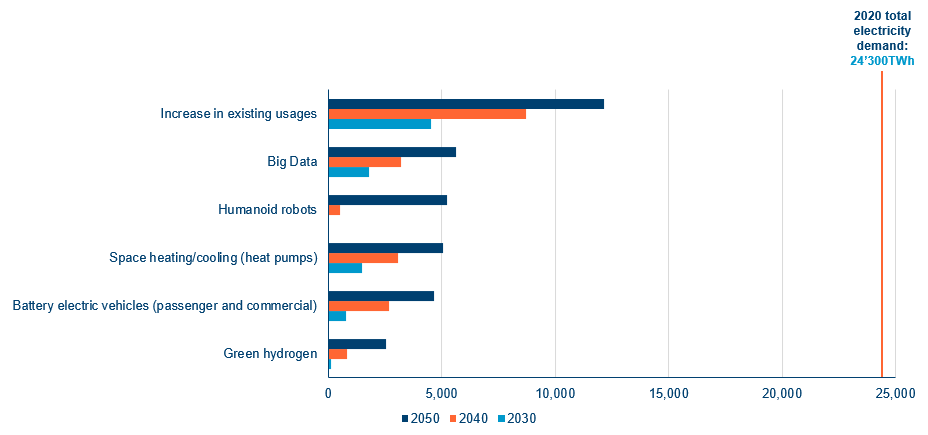
Big Data, humanoid robots, heat pumps, EVs and green H2 driving strong demand
Electricity demand growth from 2020

Electricity demand growth from 2020
Source: Polar Capital estimates as at July 2023; BNEF for historical figures. Forecasts contained herein are for illustrative purposes only and does not constitute advice or a recommendation. Some information contained herein has been obtained from third party sources and has not been independently verified by Polar Capital. Neither Polar Capital nor any other party involved makes any express or implied warranties or representations.

As a matter of fact, the share of electricity in energy use is currently at 20%, and is expected to grow to close to 60% in 2050 according to our estimates, offering significant investment opportunities over a wide range of all the different end markets over many years to come. The rise of physical AI is also supposed to emerge as a significant new driver of electricity demand, though the full scale of its future electricity requirements remains difficult to quantify at this stage. To ensure cost-effectiveness, humanoid robots, autonomous vehicles and other smart mobile devices must prioritise energy efficiency. These systems process real-time data to sense, think and act, with their efficiencies determining battery capacity and overall weight.

Through the new demand drivers, the opportunity set across Smart Energy will just become even more diversified across end markets and geographies. System optimisation through pushing energy efficiency innovations will be key for market participants to compete successfully against peers, be it in industrial, automotive or building end markets, or in the new areas of data centres and physical AI. Looking ahead, the energy transition is entering a new phase, often termed the “electrification megacycle”, where surging demand in new areas of activities such as AI data centres, electrified transport, heat pumps and industrial automation is adding momentum to the decarbonisation targets. In an even more forward-looking approach, emerging initiatives using solar power in space for orbital computing, or to beam the energy back to Earth via microwaves might offer fascinating new possibilities.

Risks:

  • Capital is at risk and there is no guarantee the Fund will achieve its objective. Investors should make sure their attitude towards risk is aligned with the risk profile of the Fund before investing.
  • Past performance is not a reliable guide to future performance. The value of investments may go down as well as up and you might get back less than you originally invested as there is no guarantee in place.
  • The value of a fund’s assets may be affected by uncertainties such as international political developments, market sentiment, economic conditions, changes in government policies, restrictions on foreign investment and currency repatriation, currency fluctuations and other developments in the laws and regulations of countries in which investment may be made. Please see the Fund’s Prospectus for details of all risks.
  • The fund is exposed to Sustainability risks which are environmental, social and governance factors that could have an actual or potential material negative impact on the value of the Fund and its risk factors.
  • The Fund invests in the shares of companies and share prices can rise or fall due to several factors affecting global stock markets.
  • The Fund uses derivatives which carry the risk of reduced liquidity, substantial loss, and increased volatility in adverse market conditions, such as failure amongst market participants.
  • The Fund invests in assets denominated in currencies other than the Fund's base currency. Changes in exchange rates may have a negative impact on the Fund's investments. If the share class currency is different from the currency of the country in which you reside, exchange rate fluctuations may affect your returns when converted into your local currency.
  • The Fund invests in emerging markets where there is a greater risk of volatility due to political and economic uncertainties, restrictions on foreign investment, currency repatriation and currency fluctuations. Developing markets are typically less liquid which may result in large price movements to the Fund.
  • The Fund invests in a relatively concentrated number of companies and industries based in one sector. This focused strategy can produce high gains but can also lead to significant losses. The Fund may be less diversified than other investment funds.


Important Information
: This is a marketing communication and does not constitute a solicitation or offer to any person to buy or sell any related securities or financial instruments. Any opinions expressed may change. This document does not contain information material to the investment objectives or financial needs of the recipient. This document is not advice on legal, taxation or investment matters. Tax treatment depends on personal circumstances. Investors must rely on their own examination of the fund or seek advice. Investment may be restricted in other countries and as such, any individual who receives this document must make themselves aware of their respective jurisdiction and observe any restrictions.

A decision may be taken at any time to terminate the marketing of the Fund in any EEA Member State in which it is currently marketed. Shareholders in the affected EEA Member State will be given notification of any decision and provided the opportunity to redeem their interests in the Fund, free of any charges or deductions, for at least 30 working days from the date of the notification.

Investment in the Fund is an investment in the shares of the Fund and not in the underlying investments of the Fund. Further information about fund characteristics and any associated risks can be found in the Fund’s Key Information Document or Key Investor Information Document (“KID” or “KIID”), the Prospectus (and relevant Fund Supplement), the Articles of Association and the Annual and Semi-Annual Reports. Please refer to these documents before making any final investment decisions.  Investment in the Fund concerns shares of the Fund and not in the underlying investments of the Fund. These documents are available free of charge at Polar Capital Funds plc, Georges Court, 54-62 Townsend Street, Dublin 2, Ireland, via email by contacting Investor-Relations@polarcapitalfunds.com or at www.polarcapital.co.uk. The KID is available in the languages of all EEA member states in which the Fund is registered for sale; the Prospectus, Annual and Semi-Annual Reports and KIID are available in English.

The Fund promotes environmental and/or social characteristics and is classified as an Article 9 fund under the EU’s Sustainable Finance Disclosure Regulation (“SFDR”). For more information, please see the Fund Supplement and Prospectus or by visiting www.polarcapital.co.uk.

ESG and sustainability characteristics are further detailed on the investment manager’s websites. - https://www.polarcapital.co.uk/ESG-and-Sustainability/Responsible-Investing/.

A summary of investor rights associated with investment in the Fund can be found here.

This document is provided and approved by both Polar Capital LLP and Polar Capital (Europe) SAS.

Polar Capital LLP is authorised and regulated by the Financial Conduct Authority (“FCA”) in the United Kingdom, and the Securities and Exchange Commission (“SEC”) in the United States. Polar Capital LLP’s registered address is 16 Palace Street, London, SW1E 5JD, United Kingdom.

Polar Capital (Europe) SAS is authorised and regulated by the Autorité des marchés financiers (AMF) in France. Polar Capital (Europe) SAS’s registered address is 18 Rue de Londres, Paris 75009, France.

Polar Capital LLP is a registered Investment Advisor with the SEC. Polar Capital LLP is the investment manager and promoter of Polar Capital Funds plc – an open-ended investment company with variable capital and with segregated liability between its sub-funds – incorporated in Ireland, authorised by the Central Bank of Ireland and recognised by the FCA. FundRock Management Company (Ireland) Limited acts as management company and is regulated by the Central Bank of Ireland. Registered Address: Percy Exchange, 8/34 Percy Place, Dublin 4, Ireland.

For UK investors: The Fund is recognised in the UK under the Overseas Funds Regime (OFR) but it is not a UK-authorised Fund. UK investors should be aware that they may not be able to refer a complaint against its Management Company or its Depositary to the UK’s Financial Ombudsman Service. Any claims for losses relating to the Management Company or the Depositary will not be covered by the Financial Services Compensation Scheme, in the event that either entity should become unable to meet its liabilities to investors. For information on the complaint process to the Management Company, please see the Country Supplement for this fund available at https://www.polarcapital.co.uk/.

Polar Capital (Switzerland) AG is the investment manager of the Fund and is authorised and regulated by the Swiss Financial Market Supervisory Authority (“FINMA”). Registered address Klausstrasse 4, 8008, Zurich, Switzerland. FundRock Management Company (Ireland) Limited acts as management company and is regulated by the Central Bank of Ireland. Registered Address: Percy Exchange, 8/34 Percy Place, Dublin 4, Ireland.

Benchmark: The Fund is actively managed and uses the MSCI ACWI Net TR Index. The benchmark has been chosen as it is generally considered to be representative of the investment universe in which the Fund invests. The performance of the Fund is likely to differ from the performance of the benchmark as the holdings, weightings and asset allocation will be different. Investors should carefully consider these differences when making comparisons. Further information about the benchmark can be found here. The benchmark is provided by an administrator on the European Securities and Markets Authority (ESMA) register of benchmarks which includes details of all authorised, registered, recognised and endorsed EU and third country benchmark administrators together with their national competent authorities.

Third-party Data: Some information contained herein has been obtained from third party sources and has not been independently verified by Polar Capital. Neither Polar Capital nor any other party involved in or related to compiling, computing or creating the data makes any express or implied warranties or representations with respect to such data (or the results to be obtained by the use thereof), and all such parties hereby expressly disclaim all warranties of originality, accuracy, completeness, merchantability or fitness for a particular purpose with respect to any data contained herein.

Country Specific Disclaimers: Please be aware that not every share class of every fund is available in all jurisdictions. Please be aware that not every share class of every fund is available in all jurisdictions. When considering an investment into the Fund, you should make yourself aware of the relevant financial, legal and tax implications. Neither Polar Capital LLP, Polar Capital Funds PLC or Polar Capital (Switzerland) AG shall be held liable for, and accept no liability for, the use or misuse of this document.

None

The Polar Capital Sustainable Thematic Equity team project that electricity is set to rise from 20% of global energy use today to nearly 60% by 2050. In this Q&A Thiemo Lang, Senior Portfolio Manager of the Polar Capital Smart Energy Fund, explores how the portfolio is positioned to capitalise on this long-term structural trend. Thiemo also offers some reflections as the Fund approaches its five-year anniversary later this year and gives his outlook for the next five.

Q1: Decarbonisation is a long-term trend. What are the main drivers and what are currently the biggest challenges? What impact can shorter-term policy or geopolitics have on the trend and your portfolio?

A: Decarbonisation has been driven by initiatives worldwide aiming to reduce carbon emissions through moving to carbon-free power generation and implementing energy efficiency measures. Decarbonisation and the electrification of end markets are closely interlinked. Shorter-term policy and geopolitical developments can create volatility, particularly in areas such as subsidy regimes, trade restrictions or supply chains for critical materials. However, the Fund is constructed to focus on solution providers rather than policy-dependent outcomes. Many of our holdings benefit from electrification, efficiency and infrastructure investment regardless of the precise pace or direction of individual policy measures. This is especially evident with the recent surge in demand driven by AI data centres. Geopolitical uncertainty generally strengthens the argument for energy security, grid resilience and localised supply chains, all of which align with the Fund’s core investment themes.

Q2: From an investor’s perspective, what are the most interesting investment opportunities in Smart Energy?

A: The most compelling opportunities today sit at the intersection of rapidly rising electricity demand and structural bottlenecks in the system. This dynamic is particularly apparent in AI infrastructure, where data centre operators are increasingly constrained by the speed at which new power connections can be secured. Grid constraints, delays in getting permits, the intermittency of renewables and shortages in key electrical equipment such as transformers, switchgear and cables have become blockages. This is accelerating investment not only in grids, but also in behind-the-meter solutions such as onsite generation and large-scale battery systems that allow operators to manage peak loads and secure faster project timelines.

Over the next few years, access to reliable and sufficient power rather than computing hardware is expected to become the primary bottleneck for AI deployment. The current rush to build out data centres is shifting gears: from “time to power” to a mission for maximum efficiency. Due to grid transmission inefficiencies, power conversion losses, and the rigorous cooling needs of liquid-cooled chips, the total electricity required at the source is approximately twice the amount used for actual computation. This is driving strong demand for energy-efficient electrical infrastructure, transformers, power semiconductors, power supplies and cooling systems – all areas where the Fund has significant exposure.

Besides the investments linked to the build-out of IT power infrastructure, the “electrification of everything” trend encompasses a wide range of opportunities across the transportation, building and industrial sectors.

Besides the investments linked to the build-out of IT power infrastructure, the “electrification of everything” trend encompasses a wide range of opportunities across the transportation, building and industrial sectors. Barring further external shocks, we expect the visibility into the industrial electrification segments to improve considerably. Given the very lean inventories, this should notably profit the industrial semiconductor companies supplying the industrial automation segments.

Global energy storage systems (ESS) are expected to maintain robust capacity growth in 2026 of >40% y/y, underpinned by increasing grid-stability requirements, accelerating electricity demand from AI-driven data centers, and ongoing improvements in system costs and efficiency. In addition, expanding revenue opportunities in capacity and ancillary services markets are strengthening the investment case for storage.

2026 will also be the year where we will see first major rollouts of humanoid robots. Rapid advances in AI, combined with falling hardware costs, are accelerating this transition, enabling robots’ deployment beyond traditional industrial uses and into services and households. As humanoid robots become more sophisticated and widespread, their power demands are becoming a wider issue, having significant impact on their overall economics. Energy-efficient robots will operate longer per charge, require fewer battery replacements and have lower maintenance costs, ultimately improving total cost of ownership.

Q3: How do you implement those opportunities to construct a diverse, thematic portfolio? Could you give a few examples?

A: The Fund is structured around four core investment clusters that together capture the electrification megacycle: clean power generation, energy transmission and distribution, energy conversion and storage, and energy efficiency.

Within each cluster, we invest across multiple subsectors and geographies to maintain diversification and avoid overexposure to any single technology or regulatory risk. Portfolio construction is driven by bottom-up fundamental research, with sustainability analysis fully integrated into the investment process.

This approach allows the portfolio to capture multiple points of value creation along the energy system, from upstream electricity infrastructure to downstream efficiency gains inside data centres, factories and buildings, rather than relying on any single technology or policy outcome. Position sizing reflects conviction, liquidity and risk contribution, ensuring that no single theme or stock dominates overall portfolio outcomes.

Q4: Renewable power producers currently play a relatively minor role in the portfolio. Why?

A: Renewable power generation is essential to decarbonisation, and the buildout of new solar and wind capacity over the past two decades has been impressive. Meanwhile, as the market share of solar and wind has already significantly increased in many developed markets, their intermittency affects supply and pricing during periods of high generation. Any further buildout of renewable power generation must therefore be accommodated by even more investments in grid infrastructure or storage solutions.

The energy transition is not linear, with technologies, end markets and winners evolving over time. Focusing on companies with strong balance sheets, technological leadership and exposure to multiple structural growth drivers has been critical to navigating volatility while maintaining long-term thematic purity.

Battery-based storage solutions can be economically used for daily load shifting, but are not suited for seasonal storage. A compelling way to store surplus renewable electricity over a longer period of time would be its conversion into green hydrogen. Though we still believe this will be a very viable long-term option, we do not expect a more meaningful launch in green hydrogen storage solution before the next decade.

We therefore expect a further buildout of solar and wind over the next years, but we are not expecting strong growth rates in this segment compared to grid and battery storage solution investments.

Q5: The Fund celebrates its five-year anniversary in September this year. What are your main reflections on the first five years and what is your outlook for the next five?

Reflections on the first five years

The first five years have demonstrated both the cyclicality and the resilience of clean energy investing. The period has included sharp market rotations, rising interest rates and shifting policy environments. Throughout this, the importance of active management, fundamental research and diversification across the value chain has been reinforced.

The energy transition is not linear, with technologies, end markets and winners evolving over time. Focusing on companies with strong balance sheets, technological leadership and exposure to multiple structural growth drivers has been critical to navigating volatility while maintaining long-term thematic purity.

This experience has reinforced the importance of flexibility within a long-term thematic framework, as new demand drivers can emerge faster than expected.

Outlook for the next five

The “electrify everything” trend is set to further accelerate over the next five years. AI data centres are emerging as a strong new demand driver, placing unprecedented pressure on existing power generation assets and grid infrastructure. Various solutions are currently being investigated and processed to cover their surging electricity needs, including onsite power generation and battery storage and further buildout of the electrical grid. Even data centres in space are being discussed, eliminating the need of sophisticated liquid cooling, and the power needs covered by solar panels in space, permanently oriented toward the sun, providing uninterrupted energy. We are also witnessing a renaissance of nuclear power, as their supply of baseload power fits perfectly well the round the clock energy needs of data centres. Advanced reactor designs have incorporated passive safety systems designed to shut down without human intervention, and new modular solutions are expected to drive down manufacturing and installation costs.

While the global discussion on rising energy consumption is currently centred on the buildout of AI data centres, we should not forget that this trend is so far mostly heavily met by the US market. In other geographies such as Europe and Asia we still have other meaningful demand drivers such as the further electrification of the transportation sector through electric vehicles, as well as further deployments of heat pumps and HVACs.

Big Data, humanoid robots, heat pumps, EVs and green H2 driving strong demand
Electricity demand growth from 2020

Electricity demand growth from 2020
Source: Polar Capital estimates as at July 2023; BNEF for historical figures. Forecasts contained herein are for illustrative purposes only and does not constitute advice or a recommendation. Some information contained herein has been obtained from third party sources and has not been independently verified by Polar Capital. Neither Polar Capital nor any other party involved makes any express or implied warranties or representations.

As a matter of fact, the share of electricity in energy use is currently at 20%, and is expected to grow to close to 60% in 2050 according to our estimates, offering significant investment opportunities over a wide range of all the different end markets over many years to come. The rise of physical AI is also supposed to emerge as a significant new driver of electricity demand, though the full scale of its future electricity requirements remains difficult to quantify at this stage. To ensure cost-effectiveness, humanoid robots, autonomous vehicles and other smart mobile devices must prioritise energy efficiency. These systems process real-time data to sense, think and act, with their efficiencies determining battery capacity and overall weight.

Through the new demand drivers, the opportunity set across Smart Energy will just become even more diversified across end markets and geographies. System optimisation through pushing energy efficiency innovations will be key for market participants to compete successfully against peers, be it in industrial, automotive or building end markets, or in the new areas of data centres and physical AI. Looking ahead, the energy transition is entering a new phase, often termed the “electrification megacycle”, where surging demand in new areas of activities such as AI data centres, electrified transport, heat pumps and industrial automation is adding momentum to the decarbonisation targets. In an even more forward-looking approach, emerging initiatives using solar power in space for orbital computing, or to beam the energy back to Earth via microwaves might offer fascinating new possibilities.

Related Fund

Risks:

  • Capital is at risk and there is no guarantee the Fund will achieve its objective. Investors should make sure their attitude towards risk is aligned with the risk profile of the Fund before investing.
  • Past performance is not a reliable guide to future performance. The value of investments may go down as well as up and you might get back less than you originally invested as there is no guarantee in place.
  • The value of a fund’s assets may be affected by uncertainties such as international political developments, market sentiment, economic conditions, changes in government policies, restrictions on foreign investment and currency repatriation, currency fluctuations and other developments in the laws and regulations of countries in which investment may be made. Please see the Fund’s Prospectus for details of all risks.
  • The fund is exposed to Sustainability risks which are environmental, social and governance factors that could have an actual or potential material negative impact on the value of the Fund and its risk factors.
  • The Fund invests in the shares of companies and share prices can rise or fall due to several factors affecting global stock markets.
  • The Fund uses derivatives which carry the risk of reduced liquidity, substantial loss, and increased volatility in adverse market conditions, such as failure amongst market participants.
  • The Fund invests in assets denominated in currencies other than the Fund's base currency. Changes in exchange rates may have a negative impact on the Fund's investments. If the share class currency is different from the currency of the country in which you reside, exchange rate fluctuations may affect your returns when converted into your local currency.
  • The Fund invests in emerging markets where there is a greater risk of volatility due to political and economic uncertainties, restrictions on foreign investment, currency repatriation and currency fluctuations. Developing markets are typically less liquid which may result in large price movements to the Fund.
  • The Fund invests in a relatively concentrated number of companies and industries based in one sector. This focused strategy can produce high gains but can also lead to significant losses. The Fund may be less diversified than other investment funds.


Important Information
: This is a marketing communication and does not constitute a solicitation or offer to any person to buy or sell any related securities or financial instruments. Any opinions expressed may change. This document does not contain information material to the investment objectives or financial needs of the recipient. This document is not advice on legal, taxation or investment matters. Tax treatment depends on personal circumstances. Investors must rely on their own examination of the fund or seek advice. Investment may be restricted in other countries and as such, any individual who receives this document must make themselves aware of their respective jurisdiction and observe any restrictions.

A decision may be taken at any time to terminate the marketing of the Fund in any EEA Member State in which it is currently marketed. Shareholders in the affected EEA Member State will be given notification of any decision and provided the opportunity to redeem their interests in the Fund, free of any charges or deductions, for at least 30 working days from the date of the notification.

Investment in the Fund is an investment in the shares of the Fund and not in the underlying investments of the Fund. Further information about fund characteristics and any associated risks can be found in the Fund’s Key Information Document or Key Investor Information Document (“KID” or “KIID”), the Prospectus (and relevant Fund Supplement), the Articles of Association and the Annual and Semi-Annual Reports. Please refer to these documents before making any final investment decisions.  Investment in the Fund concerns shares of the Fund and not in the underlying investments of the Fund. These documents are available free of charge at Polar Capital Funds plc, Georges Court, 54-62 Townsend Street, Dublin 2, Ireland, via email by contacting Investor-Relations@polarcapitalfunds.com or at www.polarcapital.co.uk. The KID is available in the languages of all EEA member states in which the Fund is registered for sale; the Prospectus, Annual and Semi-Annual Reports and KIID are available in English.

The Fund promotes environmental and/or social characteristics and is classified as an Article 9 fund under the EU’s Sustainable Finance Disclosure Regulation (“SFDR”). For more information, please see the Fund Supplement and Prospectus or by visiting www.polarcapital.co.uk.

ESG and sustainability characteristics are further detailed on the investment manager’s websites. - https://www.polarcapital.co.uk/ESG-and-Sustainability/Responsible-Investing/.

A summary of investor rights associated with investment in the Fund can be found here.

This document is provided and approved by both Polar Capital LLP and Polar Capital (Europe) SAS.

Polar Capital LLP is authorised and regulated by the Financial Conduct Authority (“FCA”) in the United Kingdom, and the Securities and Exchange Commission (“SEC”) in the United States. Polar Capital LLP’s registered address is 16 Palace Street, London, SW1E 5JD, United Kingdom.

Polar Capital (Europe) SAS is authorised and regulated by the Autorité des marchés financiers (AMF) in France. Polar Capital (Europe) SAS’s registered address is 18 Rue de Londres, Paris 75009, France.

Polar Capital LLP is a registered Investment Advisor with the SEC. Polar Capital LLP is the investment manager and promoter of Polar Capital Funds plc – an open-ended investment company with variable capital and with segregated liability between its sub-funds – incorporated in Ireland, authorised by the Central Bank of Ireland and recognised by the FCA. FundRock Management Company (Ireland) Limited acts as management company and is regulated by the Central Bank of Ireland. Registered Address: Percy Exchange, 8/34 Percy Place, Dublin 4, Ireland.

For UK investors: The Fund is recognised in the UK under the Overseas Funds Regime (OFR) but it is not a UK-authorised Fund. UK investors should be aware that they may not be able to refer a complaint against its Management Company or its Depositary to the UK’s Financial Ombudsman Service. Any claims for losses relating to the Management Company or the Depositary will not be covered by the Financial Services Compensation Scheme, in the event that either entity should become unable to meet its liabilities to investors. For information on the complaint process to the Management Company, please see the Country Supplement for this fund available at https://www.polarcapital.co.uk/.

Polar Capital (Switzerland) AG is the investment manager of the Fund and is authorised and regulated by the Swiss Financial Market Supervisory Authority (“FINMA”). Registered address Klausstrasse 4, 8008, Zurich, Switzerland. FundRock Management Company (Ireland) Limited acts as management company and is regulated by the Central Bank of Ireland. Registered Address: Percy Exchange, 8/34 Percy Place, Dublin 4, Ireland.

Benchmark: The Fund is actively managed and uses the MSCI ACWI Net TR Index. The benchmark has been chosen as it is generally considered to be representative of the investment universe in which the Fund invests. The performance of the Fund is likely to differ from the performance of the benchmark as the holdings, weightings and asset allocation will be different. Investors should carefully consider these differences when making comparisons. Further information about the benchmark can be found here. The benchmark is provided by an administrator on the European Securities and Markets Authority (ESMA) register of benchmarks which includes details of all authorised, registered, recognised and endorsed EU and third country benchmark administrators together with their national competent authorities.

Third-party Data: Some information contained herein has been obtained from third party sources and has not been independently verified by Polar Capital. Neither Polar Capital nor any other party involved in or related to compiling, computing or creating the data makes any express or implied warranties or representations with respect to such data (or the results to be obtained by the use thereof), and all such parties hereby expressly disclaim all warranties of originality, accuracy, completeness, merchantability or fitness for a particular purpose with respect to any data contained herein.

Country Specific Disclaimers: Please be aware that not every share class of every fund is available in all jurisdictions. Please be aware that not every share class of every fund is available in all jurisdictions. When considering an investment into the Fund, you should make yourself aware of the relevant financial, legal and tax implications. Neither Polar Capital LLP, Polar Capital Funds PLC or Polar Capital (Switzerland) AG shall be held liable for, and accept no liability for, the use or misuse of this document.