


'All Gaul is divided into three parts…'
– Caesar, Commentarii de Bello Gallico, Book I
So begins Caesar's account of his campaigns in Gaul in the first century BC. Given France's current political divisions, he could almost be writing today. Since the snap election of 2024, the French National Assembly has been split broadly between three blocs, with none able to command a majority. Budget negotiations have since brought down two prime ministers, and Sébastien Lecornu now leads a minority government that must secure parliamentary support for the 2027 budget.
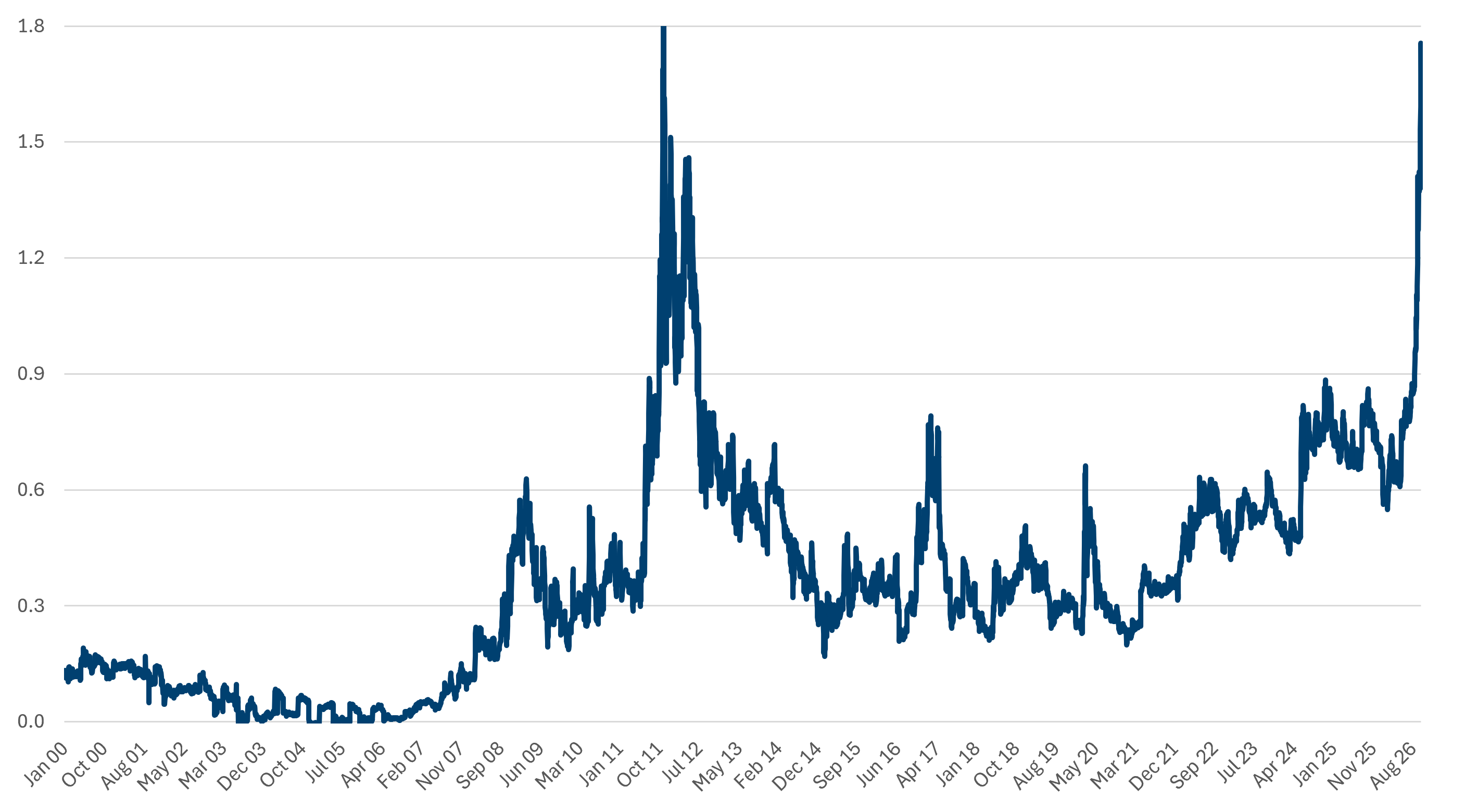
This situation has not gone unnoticed by bond markets. French government bond (OAT) yields have risen materially in 2026. Year to date the yield on 10-year OATs has, for example, risen by 146 basis points (bps), reaching its highest level since the summer of 2002. This compares with average increases of 83bps across the G7 and 79bps across the former eurozone periphery (Portugal, Italy, Ireland, Greece and Spain). While France is evidently not alone in experiencing higher yields, it has suffered most. The underperformance is also evident in the spread over German Bunds. This has widened to c167bps, in excess of all the peripheral countries, and its highest level since the eurozone sovereign debt crisis of 2011-12.
| OAT-Bund spread (%) |
 |
| Source: Polar Capital, Bloomberg; October 2026 |
Why does it matter for French banks?
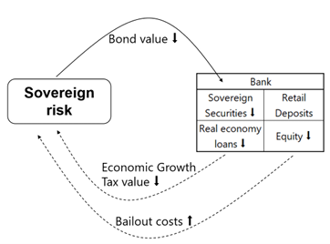
We need only cast our minds back to the eurozone sovereign debt crisis. At the time, banks held substantial amounts of sovereign debt, leaving them exposed to falling bond prices and higher funding costs. Governments, meanwhile, were increasingly called upon to support struggling banks, adding to their own fiscal pressures. With European companies heavily reliant on bank lending, the resulting contraction in credit weighed on economic activity and government finances. This self-reinforcing relationship became known as the sovereign-bank 'doom loop', or 'nexus'.
| The classic sovereign-bank doom loop |
 |
| Source: BIS Working Papers No 1369, The evolving nexus: sovereigns, banks and NBFIs; July 20261 |
Could France experience something similar today?
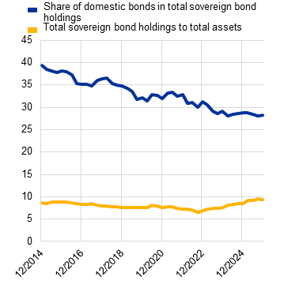
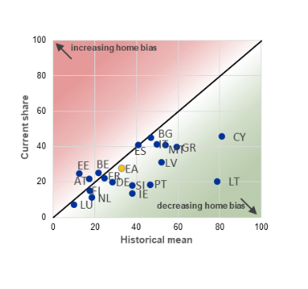
There are reasons to think not. As Claudia Buch, Chair of the ECB's Supervisory Board, noted in May2, the sovereign-bank nexus has weakened considerably since the eurozone crisis, reflecting stronger bank balance sheets and reduced exposure to domestic sovereign debt. Euro area banks' domestic sovereign holdings, for example, have fallen from 39% of their total sovereign portfolios in 2014 to around 28% at the end of 2025. Total sovereign holdings have, however, recently increased again, partly reflecting the ECB's balance sheet normalisation since 2023.
| Euro area sovereign bond holdings of euro area banks and home bias, relative to total assets | Change in home bias by country, compared with historical average |
| (Q4 2014 to Q4 2025, EUR trillions, percentages) | (Q1 to Q4 2025, percentages of total sovereign bond holdings) |
 |  |
| Source: ECB, “The bank-sovereign nexus: securing progress by completing the banking union,” Speech by Claudia Buch (Chair of the Supervisory Board), May 2026. Data based on ECB supervisory calculations. |
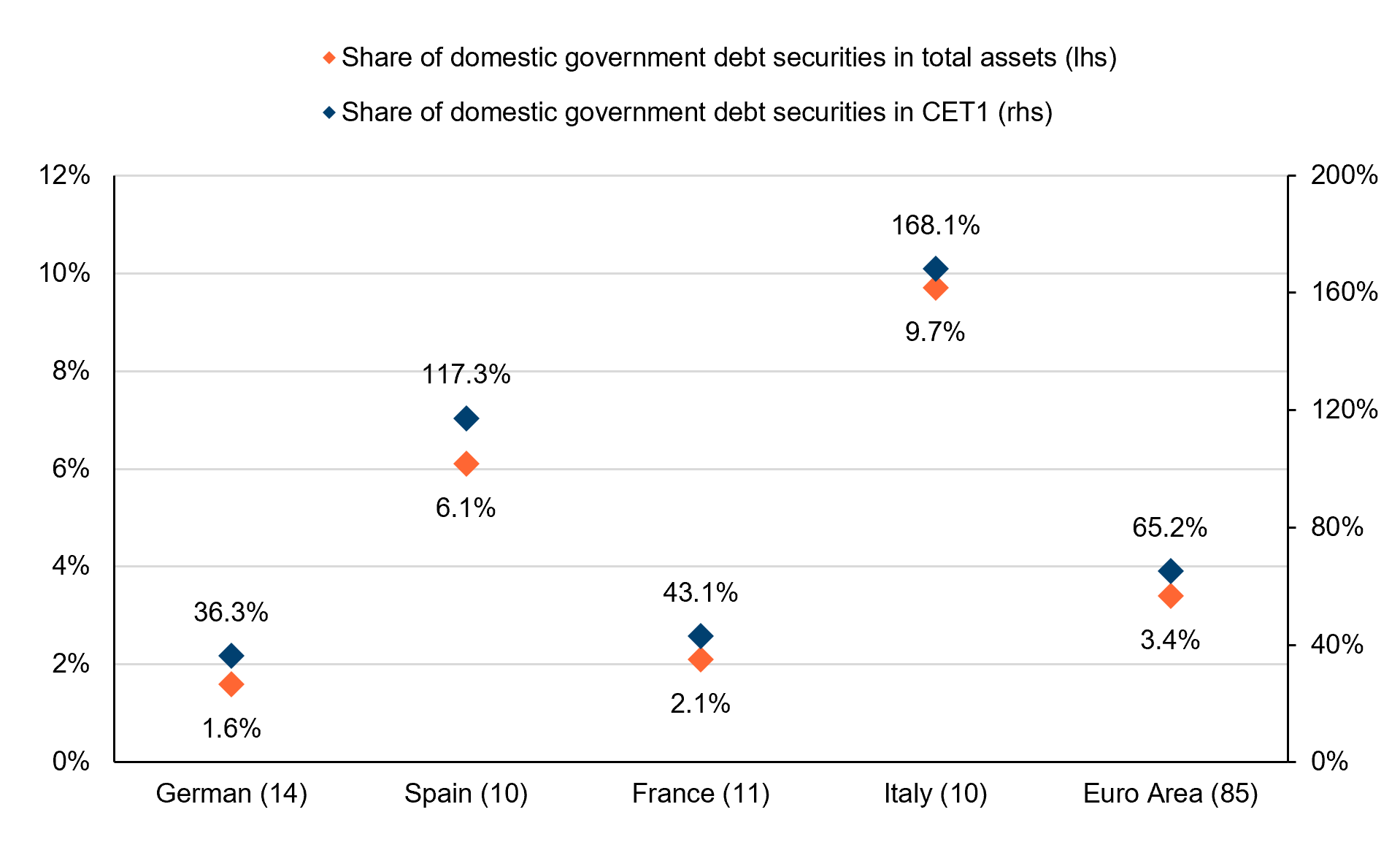
French banks also look relatively well positioned. According to the Banque de France’s June Financial Stability Report, French banks’ exposure to domestic sovereign debt accounted for just 2.1% of total assets as of 1Q26, compared with an average of 3.4% across the euro area, and 6.1% in Spain and 9.7% in Italy3.
| Exposure to domestic sovereign debt across selected European banking systems |
 |
| Source: Banque de France, June Financial Stability Report. Note: Number in the brackets shows the number of credit institutions in each sample |
Furthermore, Autonomous Research estimates that approximately 75% of disclosed French bank OAT holdings are accounted for at amortised cost (i.e. held to maturity), with a further 10% held in trading books. This leaves approximately 15% classified at fair value through other comprehensive income (FVOCI), where unrealised losses can affect regulatory capital. Consequently, Autonomous estimates that a 100bps widening in OAT–Bund spreads would reduce the CET1 ratios of BNP Paribas and Crédit Agricole by just 2bps each. For context, this spread has increased 54bps since early September.
Does this mean French banks are immune to sovereign stress?
No – while direct losses on OAT holdings appear manageable, other channels of potential impact remain.
The first is funding. Higher sovereign yields can increase wholesale funding costs, and reduce its availability, as illustrated during the eurozone sovereign debt crisis. While large French banks appear to have mostly completed their medium- and long-term issuance plans for 2026, they are still dependent on short-term wholesale funding. There is, however, currently little evidence of stress in these markets, while the Banque de France reports that French banks maintain strong liquidity positions. Access to ECB refinancing facilities also provides a further mitigation.
The second is ratings. Sovereign downgrades can feed through to bank ratings, with JP Morgan identifying Société Générale and BFCM senior preferred debt as particularly exposed to potential ratings pressure. While France avoided a downgrade from Moody's on Friday evening (rating was maintained at Aa3, negative outlook on 23 October), further rating decisions are upcoming, with S&P's next review due on 27 November (A+, stable).
Finally, weak economic growth and political uncertainty could weigh on households and businesses, potentially increasing credit losses and asset quality.
Where do we stand?
French bank credit has underperformed European peers in recent weeks, with AT1s widening c80bps from early September, compared with 40bps for the broader market.
The Polar Capital Financial Credit Fund currently has no exposure to France, and we do not believe the widening in spreads represents an attractive opportunity.
JP Morgan research notes that French bank credit spreads are not pricing materially more country risk than they did following Macron's snap election announcement in 2024. While bank fundamentals remain resilient, the additional compensation for taking French risk therefore appears relatively modest given the sovereign sell-off and unresolved fiscal outlook.
The ECB is also unlikely to provide an immediate backstop. Its Transmission Protection Instrument (TPI) is subject to fiscal eligibility criteria, which are complicated by France's ongoing Excessive Deficit Procedure. While this does not rule out intervention, it suggests sovereign spreads could widen considerably further before the ECB steps in, adding to the case for caution.
We would, however, become more constructive if valuations offered greater compensation for these risks, or if there were clearer evidence of fiscal consolidation and stabilisation in sovereign spreads. With further rating actions, budget negotiations and the April 2027 presidential election ahead, we believe there is little reason to rush.