
Physical AI: When digital intelligence meets the laws of physics

Artificial intelligence is often framed as a software revolution. In reality, its long-term impact will be governed by physics.
The first phase of AI has centred on training increasingly complex models inside energy-intensive data centres. The next phase – what we describe as physical AI – is about deploying digital intelligence into the real world: autonomous vehicles, humanoid robots, industrial automation systems and drones. In this implementation phase, algorithms must move motors, power actuators and operate continuously in dynamic environments. Unlike software, physical AI runs entirely on electricity.
| Physical AI: Bridging AI with the real world |
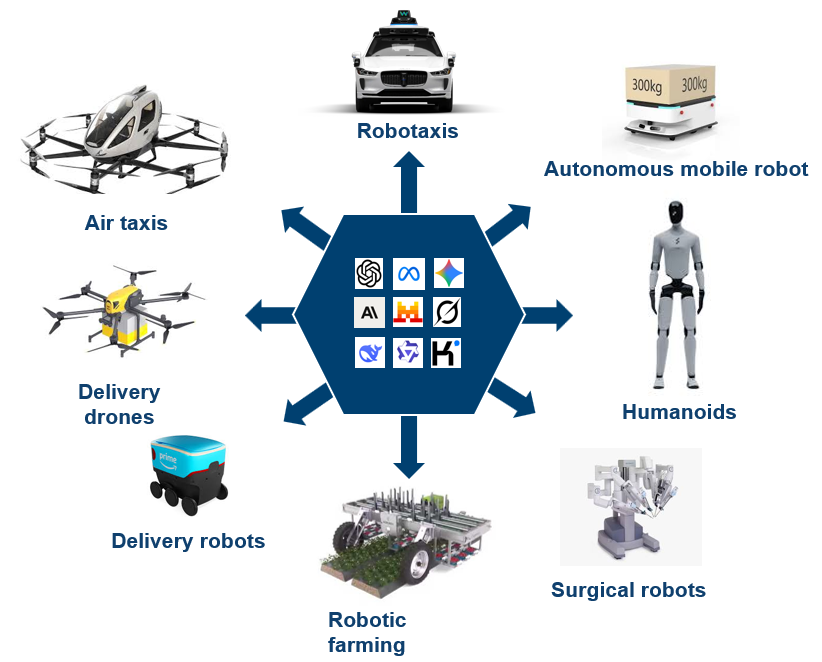 |
| Source: Polar Capital, December 2025. Images: Ateago, Agrobot, Amazon, Ehang, Figure, Intuitive Surgical, Keeta, Waymo. |
For us, this is not a peripheral theme. It sits squarely at the intersection of electrification, energy efficiency and digitisation – the core pillars of what we see as the electricity megacycle.
From training models to moving machines
While AI infrastructure remains a powerful driver of electricity demand, we believe the more profound long-term shift lies in the physical world.
Physical AI represents installing digital intelligence into machines capable of interacting with unstructured environments. Humanoid robots are the most visible example. Unlike traditional fixed-purpose industrial robots, humanoids are general-purpose systems designed to replicate human dexterity and mobility. Initial uses are concentrated in manufacturing, warehousing and logistics, where tasks are repetitive and structured. Over time, applications are likely to extend into services, healthcare and retail.
Electricity demand growth from 2020 |
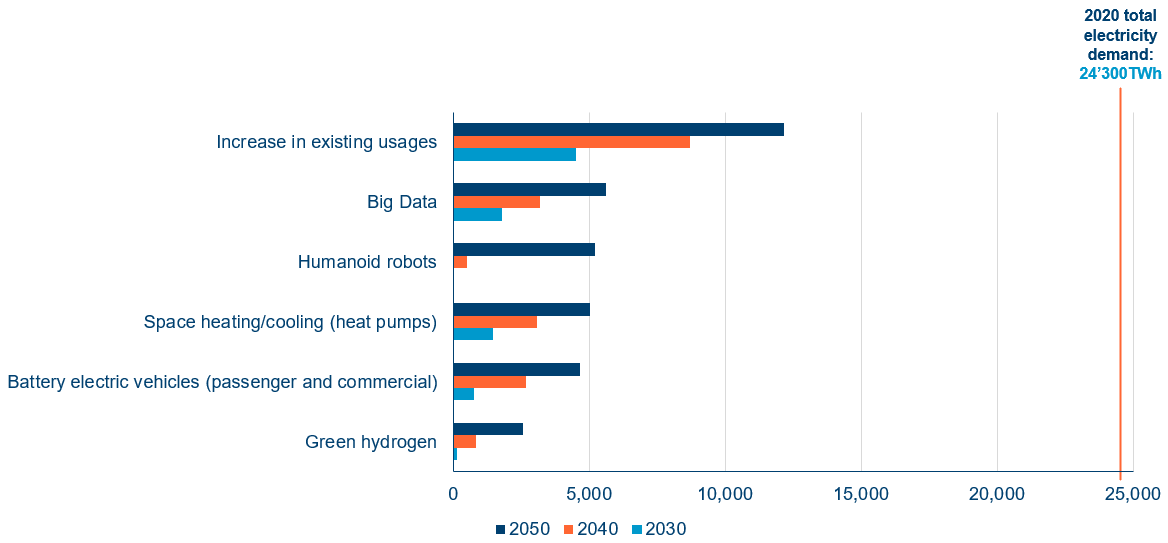 |
| Source: Polar Capital estimates as at July 2023; BNEF for historical figures. Forecasts contained herein are for illustrative purposes only and does not constitute advice or a recommendation. |
From an energy perspective, this shift is material. A current industrial humanoid consumes around 2kW during operation and can operate for only two to three hours per charge at peak load. While its peak power draw is lower than that of an electric vehicle, its average daily energy use may be higher due to longer operating hours.
Looking ahead, even under conservative efficiency assumptions, global humanoid electricity demand could reach 5,200TWh annually by 2050, exceeding current US electricity consumption. Physical AI therefore sits alongside data centres and electric vehicles as a structurally significant new source of power demand.
Economics and scale
The key question is not whether humanoids are technically feasible, but whether they are economically compelling.
Hardware costs are already declining. Average humanoid prices have fallen from more than $250,000 in 2022 to roughly $100,000-150,000 today. As scale increases and component costs fall further, payback periods are expected to shorten. Industrial humanoids currently offer payback periods of around six years, potentially declining to two years by 2030 as utilisation improves and costs fall.
Humanoid robot market to reach $5trn by 2050 |
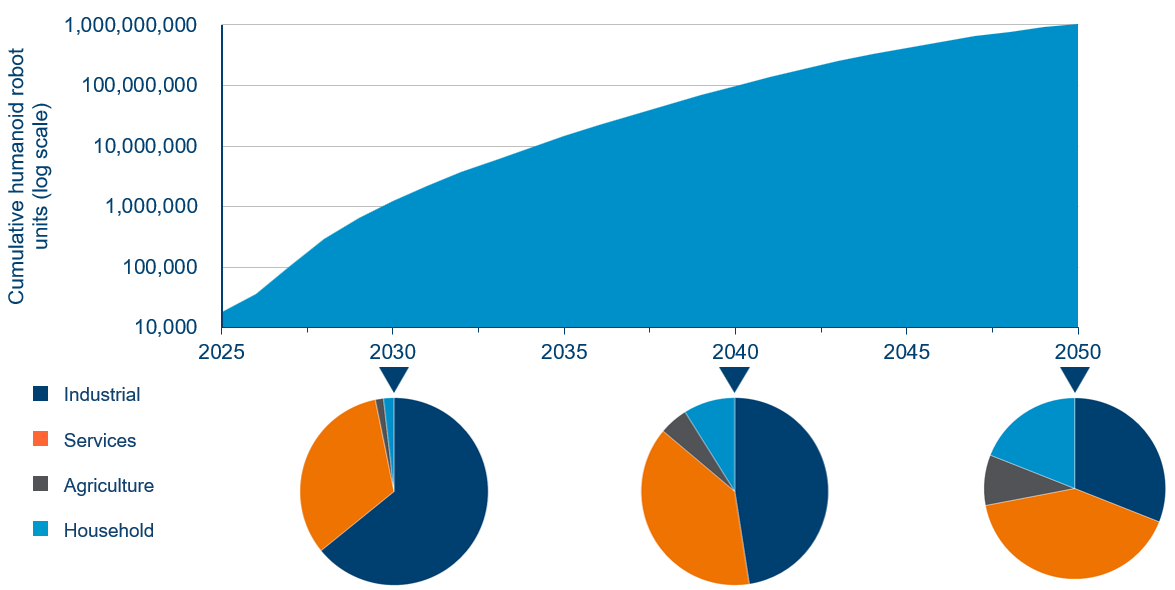 |
Source: Polar Capital estimates, 17 January 2026; https://data.worldbank.org/indicator/SL.SRV.EMPL.ZS. Forecasts contained herein are for illustrative purposes only and does not constitute advice or a recommendation. |
Under our long-term scenario, cumulative use could reach one billion units globally by 2050, implying a total addressable market of approximately $5trn. If robots can meaningfully replace or augment labour in sectors facing structural shortages and wage inflation, adoption could accelerate rapidly.
Crucially, energy efficiency remains central to the economics. Improvements in battery density, actuator performance, regenerative systems and power management directly enhance utilisation rates and total cost of ownership. In physical AI, electricity management is not a secondary consideration; it is foundational.
Geography and the manufacturing edge
While the US currently leads in frontier AI model development, physical AI may ultimately be a manufacturing-intensive competition.
China already commands significant share across robotics supply chains and benefits from deep industrial ecosystems and coordinated policy support. As humanoid production scales from thousands to millions of units, mass manufacturing capability could become a decisive advantage. For investors, this introduces both opportunity and geopolitical complexity. Selective exposure across enabling technologies rather than solely focusing on final assemblers may offer a more balanced approach.
Investing in the enablers
For the Polar Capital Smart Energy Fund, the opportunity lies less in the most visible robotics brands and more in the enabling ecosystem. Physical AI requires advanced power semiconductors, high-performance actuators, sensors, thermal management systems, optical communication infrastructure, batteries and grid-connected power equipment.
Semiconductor content per humanoid is estimated to be roughly 10x that of traditional industrial robots. The electrification intensity of physical AI is structurally higher than many legacy automation systems. Many of the companies supplying these components also serve adjacent end-markets such as data centres, electric vehicles and industrial automation, providing diversified exposure within a coherent thematic framework.
From bits to electrons
AI began as a computational story. It is becoming an energy story.
The digital intelligence being developed today will not remain confined to servers. It will inhabit machines that move, lift, assemble, inspect and transport. Every such machine will draw power from the grid. Every incremental efficiency gain in generation, transmission and conversion will matter.
Physical AI bridges software and hardware, algorithms and infrastructure. For long-term investors, the defining question is not whether automation advances, but how efficiently it is powered. In our view, the companies enabling that efficient electrification sit at the heart of one of the most compelling structural investment themes of the coming decades.