



- History rhymes: The Strait of Hormuz closure echoes the post-Trafalgar disruption of 1805 and the sudden withdrawal of a critical asset, silver, triggering a tightening of financial conditions – a topic highlighted in a recent Bank for International Settlements paper.
- Inflationary pressure is building but not yet decisive: Long-dated government bond yields have risen (40bps since February) and US headline CPI has climbed to 3.8%. We believe a durable resolution that reopens the Strait of Hormuz would likely ease pressure, while stronger central bank credibility, a less energy-intensive global economy and partially offsetting supply already help to distinguish today from the oil shocks of the 1970s.
- Positioned conservatively for duration and credit risk: The Polar Capital Financial Credit Fund maintains a short portfolio duration of 2.5 years and a strong preference for Senior and Tier 2 bonds (78%), asset classes that have historically shown greater resilience than AT1s and equities during periods of market stress.
"Massive outflows are straining the Kingdom"
Three months before the Battle of Trafalgar, Spanish Prime Minister Manuel de Godoy sent this warning to the French Finance Minister. He could not have known that Admiral Nelson was about to render this an understatement.
The Bank for International Settlements (BIS) published a working paper this month offering an interesting insight into the past. The Trafalgar Squeeze of Global Liquidity details how the Battle of Trafalgar in October 1805 severely disrupted Europe's access to Latin American silver, the dominant reserve asset of the era, triggering a financial crisis that spread from Paris to Hamburg and caused credit to collapse across the continent.
The paper argues that financial crises are exacerbated by the sudden withdrawal of whatever asset sits at the apex of the monetary hierarchy. In 1805, that asset was the Spanish silver dollar, minted in Mexico and Peru and shipped through Cádiz. Trafalgar handed Britain naval supremacy, shut down Atlantic shipping lanes and cut the flow of silver to continental Europe almost overnight.
The Banque de France, then only five years old and lacking the institutional credibility of the Bank of England, responded defensively by hoarding gold and silver reserves. The resulting contraction in money and credit tightened financial conditions materially across France and neighbouring economies.
| Price of one Spanish dollar in Paris, December 1803 to December 1806 |
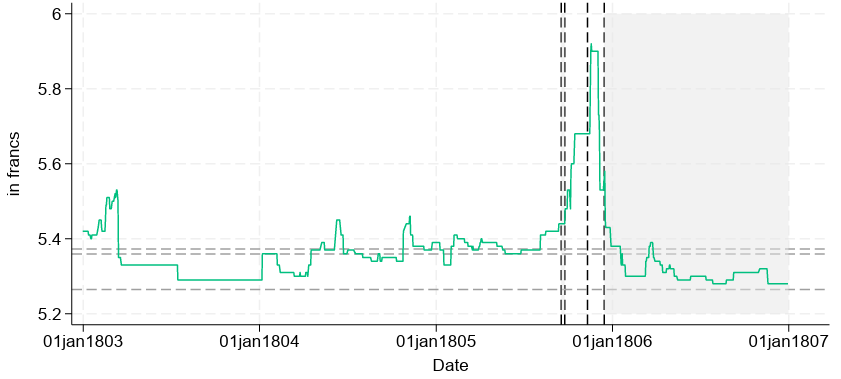 |
Source: Bank of International Settlements, The Trafalgar squeeze of global liquidity, May 2026. Horizontal lines: 5.264: Piastres export point in Cadiz; 5.3594: Intrinsic price using the average silver content; 5.3724: Intrinsic price of 1 Piastre in francs according to legal ratio. |
Are the mechanics it describes happening again, albeit in a different chokepoint with different assets?
For Cádiz, read the Strait of Hormuz.
Following US and Israeli air strikes in February, the world's most critical energy chokepoint was closed, causing tanker traffic to fall by over 90%. The immediate market response was sharp: oil prices rose materially, equities sold off and corporate bond spreads widened. Conditions subsequently stabilised amid reports of potential diplomatic progress, supported by a strong Q1 earnings season. As a result, spreads have largely retraced to pre-conflict levels, while equity markets are now higher.
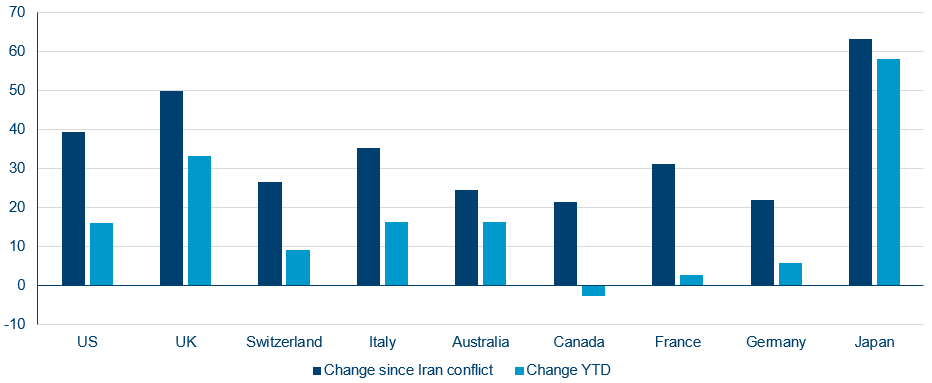
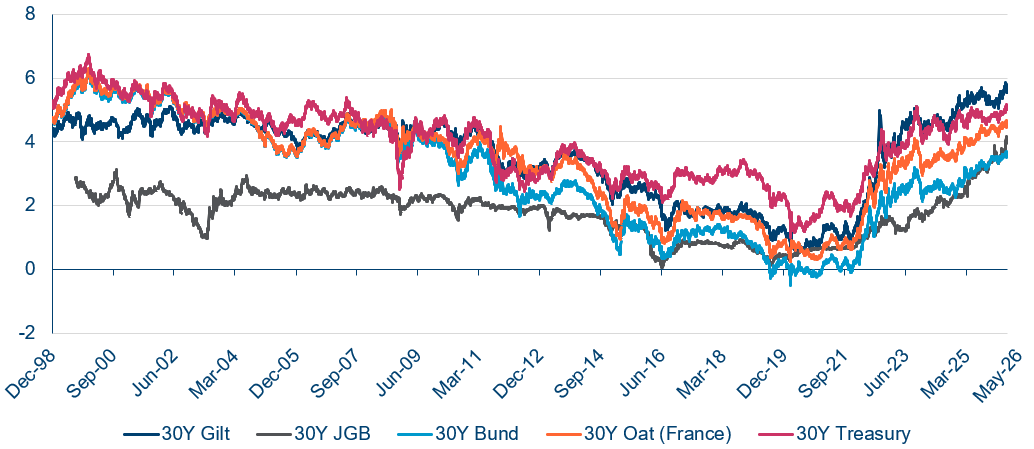
The closure, however, remains in place, and is now at risk of extending into its fourth month. In an echo to the past, financial conditions have been tightening, particularly with long government bond yields. Since the end of February, the yield on the 30-Year US Treasury has risen by 39bps to 5.0%, while equivalent gilt and Japanese government bond yields have risen by 50bps and 63bps, to 5.5% and 4.0%, respectively. For Japan, this represents a near all-time high. In the US and UK, yields are now at levels not seen for several decades, with similar moves evident across Germany and France.
While structural factors such as fiscal concerns and quantitative tightening have been pressuring long-dated government bonds since 2020, the renewed rise in yields following the Strait of Hormuz disruption suggests markets are increasingly pricing the inflationary consequences of sustained geopolitical fragmentation.
Indeed, the recent acceleration in US inflation reflects not only higher energy prices, but signs of broader price persistence. Headline CPI rose to 3.8% in April, its highest level since May 2023, while core CPI increased to 2.8%, a six-month high, reflecting continued strength in non-housing core services. Similar readings were evident in both Germany and Japan.
| Change in 30-year government bonds yields since end-2025 (basis points) |
 |
| Source: Bloomberg, Polar Capital, 28 May 2026. |
| 30-year government bonds yields since end-1998 (%) |
 |
| Source: Bloomberg, Polar Capital, 28 May 2026. |
The situation, however, differs in important respects from the oil shocks of the 1970s. The global economy is less energy intensive, energy production is geographically broader and central bank credibility is materially stronger than it was during that decade. In addition, flexible production from the Atlantic Basin, particularly the US, Brazil and Canada, has partially offset the disruption.
Indeed, crude exports from these producers have increased by approximately 3.5 million barrels per day since the end of February. According to the International Energy Agency, more than 14 million barrels per day of Middle Eastern production also remains offline, physically capable of being extracted but waiting for the export route to reopen.
As a result, a prolonged inflationary period is not inevitable. We believe a durable reopening of the Strait of Hormuz would likely ease near-term inflation pressures and reduce some of the upward pressure currently visible in long-dated bond yields.
Nevertheless, the policy dilemma facing central banks could become increasingly difficult. Persistently higher inflation combined with weakening growth raises the risk of a stagflationary environment in which policymakers must choose between defending monetary credibility and supporting economic activity. The Dallas Fed estimates that a sustained closure could reduce annualised global GDP growth by 2.9 percentage points, to potentially push several advanced economies into recession. While this is a stress scenario as opposed to a base case, and assumes the closure persists well into the second half of 2026, it illustrates the order of magnitude of the risk.
Conclusion
The post-Battle of Trafalgar tightening in liquidity and credit conditions ultimately exposed the most leveraged parts of the financial system. Several French financial institutions failed in the aftermath, including the Compagnie des Négociants Réunis1 and 20 Parisian merchant banks. Their common characteristic was concentrated leverage combined with dependence on fragile funding conditions.
While today’s banking system is substantially better capitalised, periods of tightening financial conditions have historically exposed assets with the greatest sensitivity to duration, leverage and deteriorating investor sentiment.
In light of this, we continue to favour relatively short-duration exposure, with portfolio duration remaining at 2.5 years including cash at the end of April. We also maintain a preference for Senior and Tier 2 financial bonds, which represented 78% of the Fund at the same point. The structural positioning of these instruments above AT1s and equities not only protects them from losses, but also reduces volatility, as illustrated in the table below.
| Maximum drawdowns in equities and bonds | |||||||
Spring 2016 | Spring 2020 | Spring 2022 | Early Autumn 2022 | Spring 2023 | Spring 2025 | Spring 2026 | |
| Financial Senior & Tier 2 | -0.9 | -11.2 | -3.5 | -7.9 | -3.1 | -1.5 | -2.3 |
Corporate Inv. Grade | -0.7 | -13.0 | -4.1 | -9.7 | -4.1 | -2.0 | -2.7 |
| Corporate High Yield | -4.4 | -23.9 | -7.6 | -8.0 | -4.0 | -3.0 | -2.3 |
Financial AT1 & RT1 | -10.6 | -29.1 | -8.7 | -10.9 | -19.0 | -3.9 | -3.3 |
S&P 500 Index | -10.5 | -33.8 | -13.0 | -16.9 | -7.8 | -12.1 | -9.1 |
EuroSTOXX 600 Index | -17.0 | -35.1 | -16.1 | -13.6 | -6.2 | -12.5 | -9.6 |
MSCI EM Index | -13.3 | -31.6 | -19.0 | -16.0 | -10.0 | -10.6 | -13.0 |
Financial Credit Fund | -0.8 | -1.4 | |||||
| Source: ICE BofA and Bloomberg, Polar Capital, April 2026. (The darker the red, the larger the drawdown.) | |||||||
1. The Compagnie des Négociants Réunis (CNR) or Company of United Merchants was an early 19th century financial conglomerate formed by three French bankers: Medard Desprez, Gabriel-Julien Ouvrard and Ignace-Joseph Vanlerberghe. It played a critical role in Napoleonic France, ‘simultaneously acting as lender to the sovereign, financial intermediary, military supplier and banking institution’. ‘In modern terms, the CNR functioned much like a market maker in sovereign debt’, sitting ‘at the center of a dense network of obligations linking Spain, the French Treasury, French tax collectors (receveurs géenéraux), French and other European private banks, and households.’