
"A lion used to prowl about a field in which four oxen used to dwell. Many a time he tried to attack them; but whenever he came near they turned their tails to one another, so that whichever way he approached them he was met by the horns of one of them. At last, however, they fell a-quarrelling among themselves, and each went off to pasture alone in a separate corner of the field. Then the lion attacked them one by one and soon made an end of all four."
Aesop, The Four Oxen and the Lion, c6th century BC

Aesop's fable describes a simple mechanism. When conditions change, vulnerability can emerge, and once separated from the herd, targets are easily found.

Financial markets operate in much the same way. During periods of calm, weak and strong institutions can appear remarkably similar, with bonds and equities trading at comparable valuations. The herd appears uniform.

When conditions change, however, markets are quick to identify the weakest in the pack.

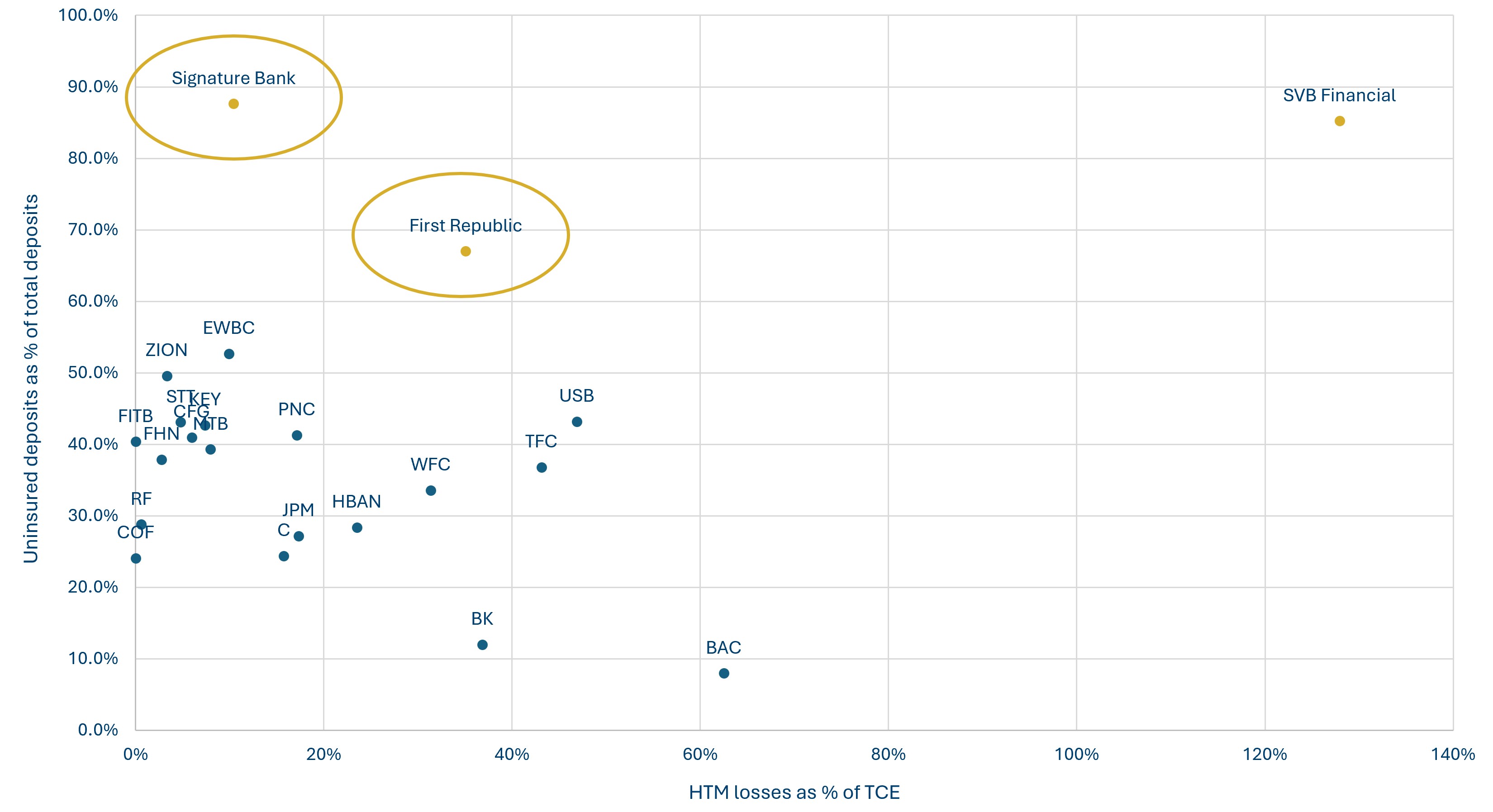
The collapse of Silicon Valley Bank (SVB) in March 2023 is the clearest recent example. Its failure reflected two vulnerabilities: a concentrated depositor base and significant unrealised losses in its held-to-maturity bond portfolio – a consequence of interest rate hikes, poor asset/liability management and a concentration of long-term bond holdings. The chart below illustrates both.

US held-to-maturity losses versus uninsured deposits (FY22) 
US held-to-maturity losses versus uninsured deposits (FY22)

Source: Companies’ 10-K filing, FY22; as at March 2023.

What followed was a reminder that markets, once spooked, quickly identify the weakest institution. Within days, Credit Suisse, already weakened by years of operational failures and reputational damage, found itself in the crosshairs.

Despite its very different business model and systemically important size and categorisation, it emerged as the weakest link in European banking. Its forced takeover by UBS over a single weekend resulted in the complete write-down of its AT1s.

The lesson is that vulnerabilities are often exposed faster than expected and rarely in the way investors anticipate.

Where we see risks today

In constructing our portfolio, we think carefully about avoiding exposure to institutions that carry the characteristics of the weakest in the pack. Three features concern us most at present.

1. Concentrated exposures

German commercial real estate (CRE) lenders are a clear example of concentrated exposures. Several smaller German banks, such as Deutsche Pfrandbriefbank (PBB) have loan books heavily weighted towards commercial real estate (offices; retail; logistics), built at valuations that have since fallen as interest rates rose, refinancing conditions tightened and structural shifts in working patterns weighed on office demand. These institutions remain solvent today but their capacity to absorb further stress is lower than more diversified peers. While that distinction is priced modestly in a calm market, it is treated more severely when markets become stressed.

2. Dependence on a single revenue stream

BFF Bank is a good example of dependence on a single revenue stream. Its model is built around factoring – purchasing receivables owed by public sector entities, primarily in Italy and other Southern European markets. It has historically been a profitable business, benefiting from the slow payment behaviour of public administrations. Its revenues, however, are not diversified across lending, fee income and treasury activity as would be the case for broader peers. As the Italian factoring market has faced regulatory change, BFF Bank has had limited ability to offset that pressure elsewhere.


Year-to-date equity and bond total return for PBB and BFF Bank


SeniorTier 2AT1Equity
Deutsche PBB0.4-4.2-4.6-18.7
BFF Bank-2.0
-10.3-71.2


Source:
Polar Capital, Bloomberg; 11 June 2026.


3. Lack of visible duration or liquidity risk

The third concern is less about what an institution lends and more about what it holds. Over the past decade, certain institutions, such as US life insurers, have meaningfully shifted their investment portfolios towards longer-duration assets and private credit in search of yield. The strategy made sense in a low interest rate environment: illiquid, complex assets offer a spread premium and long-duration liabilities appear well-matched by long-duration assets. In our view, this approach carries risks that are not always apparent until conditions change. Private credit, for example, can prove difficult to value accurately and harder still to sell in a stress scenario. While the underlying exposures may ultimately prove sound, in the short term opacity and illiquidity tend to be characteristics that markets penalise hardest when sentiment turns.

Aesop's fable reminds us that vulnerability often becomes apparent only when conditions change. Financial markets work the same way, which is why we aim to avoid being exposed to the weakest institutions in the pack.


Risks

  • Capital is at risk and there is no guarantee the Fund will achieve its objective. Investors should make sure their attitude towards risk is aligned with the risk profile of the Fund before investing.
  • Past performance is not a reliable guide to future performance. The value of investments may go down as well as up and you might get back less than you originally invested as there is no guarantee in place.
  • The value of a fund’s assets may be affected by uncertainties such as international political developments, market sentiment, economic conditions, changes in government policies, restrictions on foreign investment and currency repatriation, currency fluctuations and other developments in the laws and regulations of countries in which investment may be made. Please see the Fund’s Prospectus for details of all risks.
  • The fund is exposed to Sustainability risks which are environmental, social and governance factors that could have an actual or potential material negative impact on the value of the Fund and its risk factors.
  • The Fund invests in fixed income securities, and prices can rise or fall due to several factors affecting global markets.
  • The Fund uses derivatives which carry the risk of reduced liquidity, substantial loss, and increased volatility in adverse market conditions, such as failure amongst market participants.
  • The Fund invests in assets denominated in currencies other than the Fund's base currency. Changes in exchange rates may have a negative impact on the Fund's investments. If the share class currency is different from the currency of the country in which you reside, exchange rate fluctuations may affect your returns when converted into your local currency. Hedged share classes may have associated costs which may impact the performance of your investment.
  • There may be times where the issuer or guarantor of a fixed income security cannot meet its payment obligations or has their credit rating downgraded, resulting in potential losses for the Fund.
  • The Fund may invest in emerging markets where there is a greater risk of volatility due to political and economic uncertainties, restrictions on foreign investment, currency repatriation and currency fluctuations. Developing markets are typically less liquid which may result in large price movements to the Fund.


Important Information:
This is a marketing communication and does not constitute a solicitation or offer to any person to buy or sell any related securities or financial instruments. Any opinions expressed may change. This document does not contain information material to the investment objectives or financial needs of the recipient. This document is not advice on legal, taxation or investment matters. Tax treatment depends on personal circumstances. Investors must rely on their own examination of the fund or seek advice. Investment may be restricted in other countries and as such, any individual who receives this document must make themselves aware of their respective jurisdiction and observe any restrictions.

A decision may be taken at any time to terminate the marketing of the Fund in any EEA Member State in which it is currently marketed. Shareholders in the affected EEA Member State will be given notification of any decision and provided the opportunity to redeem their interests in the Fund, free of any charges or deductions, for at least 30 working days from the date of the notification.

Investment in the Fund is an investment in the shares of the Fund and not in the underlying investments of the Fund. Further information about fund characteristics and any associated risks can be found in the Fund’s Key Information Document or Key Investor Information Document (“KID” or “KIID”), the Prospectus (and relevant Fund Supplement), the Articles of Association and the Annual and Semi-Annual Reports. Please refer to these documents before making any final investment decisions. These documents are available free of charge at Polar Capital Funds plc, Georges Court, 54-62 Townsend Street, Dublin 2, Ireland, via email by contacting Investor-Relations@polarcapitalfunds.com or at www.polarcapital.co.uk. The KID is available in the languages of all EEA member states in which the Fund is registered for sale; the Prospectus, Annual and Semi-Annual Reports and KIID are available in English.

The Fund promotes, among other characteristics, environmental or social characteristics and is classified as an Article 8 fund under the EU's Sustainable Finance Disclosure Regulation (SFDR). For more information, please see the Prospectus and relevant Fund Supplement.

ESG and sustainability characteristics are further detailed on the investment manager’s website: - https://www.polarcapital.co.uk/ESG-and-Sustainability/Responsible-Investing/.

A summary of investor rights associated with investment in the Fund can be found here.

This document is provided and approved by both Polar Capital LLP and Polar Capital (Europe) SAS.

Polar Capital LLP is authorised and regulated by the Financial Conduct Authority (“FCA”) in the United Kingdom, and the Securities and Exchange Commission (“SEC”) in the United States. Polar Capital LLP’s registered address is 16 Palace Street, London, SW1E 5JD, United Kingdom.

Polar Capital (Europe) SAS is authorised and regulated by the Autorité des marchés financiers (AMF) in France. Polar Capital (Europe) SAS’s registered address is 18 Rue de Londres, Paris 75009, France.

Polar Capital LLP is a registered Investment Advisor with the SEC. Polar Capital LLP is the investment manager and promoter of Polar Capital Funds plc – an open-ended investment company with variable capital and with segregated liability between its sub-funds – incorporated in Ireland, authorised by the Central Bank of Ireland and recognised by the FCA. FundRock Management Company (Ireland) Limited acts as management company and is regulated by the Central Bank of Ireland. Registered Address: Percy Exchange, 8/34 Percy Place, Dublin 4, Ireland.

For UK investors: The Fund is recognised in the UK under the Overseas Funds Regime (OFR) but it is not a UK-authorised Fund. UK investors should be aware that they may not be able to refer a complaint against its Management Company or its Depositary to the UK’s Financial Ombudsman Service. Any claims for losses relating to the Management Company or the Depositary will not be covered by the Financial Services Compensation Scheme, in the event that either entity should become unable to meet its liabilities to investors. For information on the complaint process to the Management Company, please see the Country Supplement for this fund available at https://www.polarcapital.co.uk/.

Benchmark: The Fund is actively managed and uses ICE BofA Global Financial Index as a reference for performance measurement. The benchmark has been chosen as it is generally considered to be representative of the investment universe in which the Fund invests. The performance of the Fund is likely to differ from the performance of the benchmark as the holdings, weightings and asset allocation will be different. Investors should carefully consider these differences when making comparisons. Further information about the benchmark can be found here. The benchmark is provided by an administrator on the European Securities and Markets Authority (ESMA) register of benchmarks which includes details of all authorised, registered, recognised, and endorsed EU and third country benchmark administrators together with their national competent authorities.

Third-party Data: Some information contained herein has been obtained from third party sources and has not been independently verified by Polar Capital. Neither Polar Capital nor any other party involved in or related to compiling, computing or creating the data makes any express or implied warranties or representations with respect to such data (or the results to be obtained by the use thereof), and all such parties hereby expressly disclaim all warranties of originality, accuracy, completeness, merchantability or fitness for a particular purpose with respect to any data contained herein.

Country Specific Disclaimers: Please be aware that not every share class of every fund is available in all jurisdictions. When considering an investment into the Fund, you should make yourself aware of the relevant financial, legal and tax implications. Neither Polar Capital LLP nor Polar Capital Funds plc shall be liable for, and accept no liability for, the use or misuse of this document.

None

"A lion used to prowl about a field in which four oxen used to dwell. Many a time he tried to attack them; but whenever he came near they turned their tails to one another, so that whichever way he approached them he was met by the horns of one of them. At last, however, they fell a-quarrelling among themselves, and each went off to pasture alone in a separate corner of the field. Then the lion attacked them one by one and soon made an end of all four."
Aesop, The Four Oxen and the Lion, c6th century BC

Aesop's fable describes a simple mechanism. When conditions change, vulnerability can emerge, and once separated from the herd, targets are easily found.

Financial markets operate in much the same way. During periods of calm, weak and strong institutions can appear remarkably similar, with bonds and equities trading at comparable valuations. The herd appears uniform.

When conditions change, however, markets are quick to identify the weakest in the pack.

The collapse of Silicon Valley Bank (SVB) in March 2023 is the clearest recent example. Its failure reflected two vulnerabilities: a concentrated depositor base and significant unrealised losses in its held-to-maturity bond portfolio – a consequence of interest rate hikes, poor asset/liability management and a concentration of long-term bond holdings. The chart below illustrates both.

US held-to-maturity losses versus uninsured deposits (FY22) 
US held-to-maturity losses versus uninsured deposits (FY22)

Source: Companies’ 10-K filing, FY22; as at March 2023.

What followed was a reminder that markets, once spooked, quickly identify the weakest institution. Within days, Credit Suisse, already weakened by years of operational failures and reputational damage, found itself in the crosshairs.

Despite its very different business model and systemically important size and categorisation, it emerged as the weakest link in European banking. Its forced takeover by UBS over a single weekend resulted in the complete write-down of its AT1s.

The lesson is that vulnerabilities are often exposed faster than expected and rarely in the way investors anticipate.

Where we see risks today

In constructing our portfolio, we think carefully about avoiding exposure to institutions that carry the characteristics of the weakest in the pack. Three features concern us most at present.

1. Concentrated exposures

German commercial real estate (CRE) lenders are a clear example of concentrated exposures. Several smaller German banks, such as Deutsche Pfrandbriefbank (PBB) have loan books heavily weighted towards commercial real estate (offices; retail; logistics), built at valuations that have since fallen as interest rates rose, refinancing conditions tightened and structural shifts in working patterns weighed on office demand. These institutions remain solvent today but their capacity to absorb further stress is lower than more diversified peers. While that distinction is priced modestly in a calm market, it is treated more severely when markets become stressed.

2. Dependence on a single revenue stream

BFF Bank is a good example of dependence on a single revenue stream. Its model is built around factoring – purchasing receivables owed by public sector entities, primarily in Italy and other Southern European markets. It has historically been a profitable business, benefiting from the slow payment behaviour of public administrations. Its revenues, however, are not diversified across lending, fee income and treasury activity as would be the case for broader peers. As the Italian factoring market has faced regulatory change, BFF Bank has had limited ability to offset that pressure elsewhere.


Year-to-date equity and bond total return for PBB and BFF Bank


SeniorTier 2AT1Equity
Deutsche PBB0.4-4.2-4.6-18.7
BFF Bank-2.0
-10.3-71.2


Source:
Polar Capital, Bloomberg; 11 June 2026.


3. Lack of visible duration or liquidity risk

The third concern is less about what an institution lends and more about what it holds. Over the past decade, certain institutions, such as US life insurers, have meaningfully shifted their investment portfolios towards longer-duration assets and private credit in search of yield. The strategy made sense in a low interest rate environment: illiquid, complex assets offer a spread premium and long-duration liabilities appear well-matched by long-duration assets. In our view, this approach carries risks that are not always apparent until conditions change. Private credit, for example, can prove difficult to value accurately and harder still to sell in a stress scenario. While the underlying exposures may ultimately prove sound, in the short term opacity and illiquidity tend to be characteristics that markets penalise hardest when sentiment turns.

Aesop's fable reminds us that vulnerability often becomes apparent only when conditions change. Financial markets work the same way, which is why we aim to avoid being exposed to the weakest institutions in the pack.

Related Fund

Get the latest insights sent straight to your inbox

Risks

  • Capital is at risk and there is no guarantee the Fund will achieve its objective. Investors should make sure their attitude towards risk is aligned with the risk profile of the Fund before investing.
  • Past performance is not a reliable guide to future performance. The value of investments may go down as well as up and you might get back less than you originally invested as there is no guarantee in place.
  • The value of a fund’s assets may be affected by uncertainties such as international political developments, market sentiment, economic conditions, changes in government policies, restrictions on foreign investment and currency repatriation, currency fluctuations and other developments in the laws and regulations of countries in which investment may be made. Please see the Fund’s Prospectus for details of all risks.
  • The fund is exposed to Sustainability risks which are environmental, social and governance factors that could have an actual or potential material negative impact on the value of the Fund and its risk factors.
  • The Fund invests in fixed income securities, and prices can rise or fall due to several factors affecting global markets.
  • The Fund uses derivatives which carry the risk of reduced liquidity, substantial loss, and increased volatility in adverse market conditions, such as failure amongst market participants.
  • The Fund invests in assets denominated in currencies other than the Fund's base currency. Changes in exchange rates may have a negative impact on the Fund's investments. If the share class currency is different from the currency of the country in which you reside, exchange rate fluctuations may affect your returns when converted into your local currency. Hedged share classes may have associated costs which may impact the performance of your investment.
  • There may be times where the issuer or guarantor of a fixed income security cannot meet its payment obligations or has their credit rating downgraded, resulting in potential losses for the Fund.
  • The Fund may invest in emerging markets where there is a greater risk of volatility due to political and economic uncertainties, restrictions on foreign investment, currency repatriation and currency fluctuations. Developing markets are typically less liquid which may result in large price movements to the Fund.


Important Information:
This is a marketing communication and does not constitute a solicitation or offer to any person to buy or sell any related securities or financial instruments. Any opinions expressed may change. This document does not contain information material to the investment objectives or financial needs of the recipient. This document is not advice on legal, taxation or investment matters. Tax treatment depends on personal circumstances. Investors must rely on their own examination of the fund or seek advice. Investment may be restricted in other countries and as such, any individual who receives this document must make themselves aware of their respective jurisdiction and observe any restrictions.

A decision may be taken at any time to terminate the marketing of the Fund in any EEA Member State in which it is currently marketed. Shareholders in the affected EEA Member State will be given notification of any decision and provided the opportunity to redeem their interests in the Fund, free of any charges or deductions, for at least 30 working days from the date of the notification.

Investment in the Fund is an investment in the shares of the Fund and not in the underlying investments of the Fund. Further information about fund characteristics and any associated risks can be found in the Fund’s Key Information Document or Key Investor Information Document (“KID” or “KIID”), the Prospectus (and relevant Fund Supplement), the Articles of Association and the Annual and Semi-Annual Reports. Please refer to these documents before making any final investment decisions. These documents are available free of charge at Polar Capital Funds plc, Georges Court, 54-62 Townsend Street, Dublin 2, Ireland, via email by contacting Investor-Relations@polarcapitalfunds.com or at www.polarcapital.co.uk. The KID is available in the languages of all EEA member states in which the Fund is registered for sale; the Prospectus, Annual and Semi-Annual Reports and KIID are available in English.

The Fund promotes, among other characteristics, environmental or social characteristics and is classified as an Article 8 fund under the EU's Sustainable Finance Disclosure Regulation (SFDR). For more information, please see the Prospectus and relevant Fund Supplement.

ESG and sustainability characteristics are further detailed on the investment manager’s website: - https://www.polarcapital.co.uk/ESG-and-Sustainability/Responsible-Investing/.

A summary of investor rights associated with investment in the Fund can be found here.

This document is provided and approved by both Polar Capital LLP and Polar Capital (Europe) SAS.

Polar Capital LLP is authorised and regulated by the Financial Conduct Authority (“FCA”) in the United Kingdom, and the Securities and Exchange Commission (“SEC”) in the United States. Polar Capital LLP’s registered address is 16 Palace Street, London, SW1E 5JD, United Kingdom.

Polar Capital (Europe) SAS is authorised and regulated by the Autorité des marchés financiers (AMF) in France. Polar Capital (Europe) SAS’s registered address is 18 Rue de Londres, Paris 75009, France.

Polar Capital LLP is a registered Investment Advisor with the SEC. Polar Capital LLP is the investment manager and promoter of Polar Capital Funds plc – an open-ended investment company with variable capital and with segregated liability between its sub-funds – incorporated in Ireland, authorised by the Central Bank of Ireland and recognised by the FCA. FundRock Management Company (Ireland) Limited acts as management company and is regulated by the Central Bank of Ireland. Registered Address: Percy Exchange, 8/34 Percy Place, Dublin 4, Ireland.

For UK investors: The Fund is recognised in the UK under the Overseas Funds Regime (OFR) but it is not a UK-authorised Fund. UK investors should be aware that they may not be able to refer a complaint against its Management Company or its Depositary to the UK’s Financial Ombudsman Service. Any claims for losses relating to the Management Company or the Depositary will not be covered by the Financial Services Compensation Scheme, in the event that either entity should become unable to meet its liabilities to investors. For information on the complaint process to the Management Company, please see the Country Supplement for this fund available at https://www.polarcapital.co.uk/.

Benchmark: The Fund is actively managed and uses ICE BofA Global Financial Index as a reference for performance measurement. The benchmark has been chosen as it is generally considered to be representative of the investment universe in which the Fund invests. The performance of the Fund is likely to differ from the performance of the benchmark as the holdings, weightings and asset allocation will be different. Investors should carefully consider these differences when making comparisons. Further information about the benchmark can be found here. The benchmark is provided by an administrator on the European Securities and Markets Authority (ESMA) register of benchmarks which includes details of all authorised, registered, recognised, and endorsed EU and third country benchmark administrators together with their national competent authorities.

Third-party Data: Some information contained herein has been obtained from third party sources and has not been independently verified by Polar Capital. Neither Polar Capital nor any other party involved in or related to compiling, computing or creating the data makes any express or implied warranties or representations with respect to such data (or the results to be obtained by the use thereof), and all such parties hereby expressly disclaim all warranties of originality, accuracy, completeness, merchantability or fitness for a particular purpose with respect to any data contained herein.

Country Specific Disclaimers: Please be aware that not every share class of every fund is available in all jurisdictions. When considering an investment into the Fund, you should make yourself aware of the relevant financial, legal and tax implications. Neither Polar Capital LLP nor Polar Capital Funds plc shall be liable for, and accept no liability for, the use or misuse of this document.