


‘…if he should send an army against the Persians he would destroy a great empire.’: Herodotus, Histories, I.53
In the sixth century BC, Croesus, King of Lydia and, reportedly, the richest man alive, was considering war with the Persian Empire. Seeking guidance, he consulted the Oracle of Delphi. The answer appeared encouraging: any attack would result in the destruction of a great empire. Unfortunately for Croesus, while this information was correct, his interpretation was not. The empire that would ultimately fall was his own.
US Treasury Secretary Scott Bessent appears to be facing a similar problem.
Following recent US-Japanese intervention to support the yen, Bessent warned investors against taking the other side: “I have asymmetric information. I am the house now. You can bet against me if you want”. He subsequently commented that “if some of the Bloomberg terminal bros are unhappy with what I’m doing, well, that’s too bad.”
Like Croesus and the Oracle, Bessent’s confidence rests on privileged information. It is hard to dispute that advantage. Bessent almost certainly knows more than the market about what the US Treasury, Bank of Japan and Japanese government intend to do – but knowing what policymakers will do is not the same as knowing how markets will respond. This distinction is important when deciding whether such action can change market prices.
Recent Bank of America research provides a useful framework: intervention is most clearly justified where market failures, liquidity breakdowns or coordination problems are preventing efficient price discovery. The case for such action is also stronger when it is aligned with, rather than against, underlying fundamentals. The yen, for example, has a reasonable claim to being fundamentally cheap: purchasing power measures suggest substantial undervaluation and Japan continues to run a sizeable current account surplus, while interest rate differentials have narrowed. To date, therefore, such intervention appears to be reinforcing, rather than resisting, market fundamentals.
A harder case
The Treasury market looks rather different.
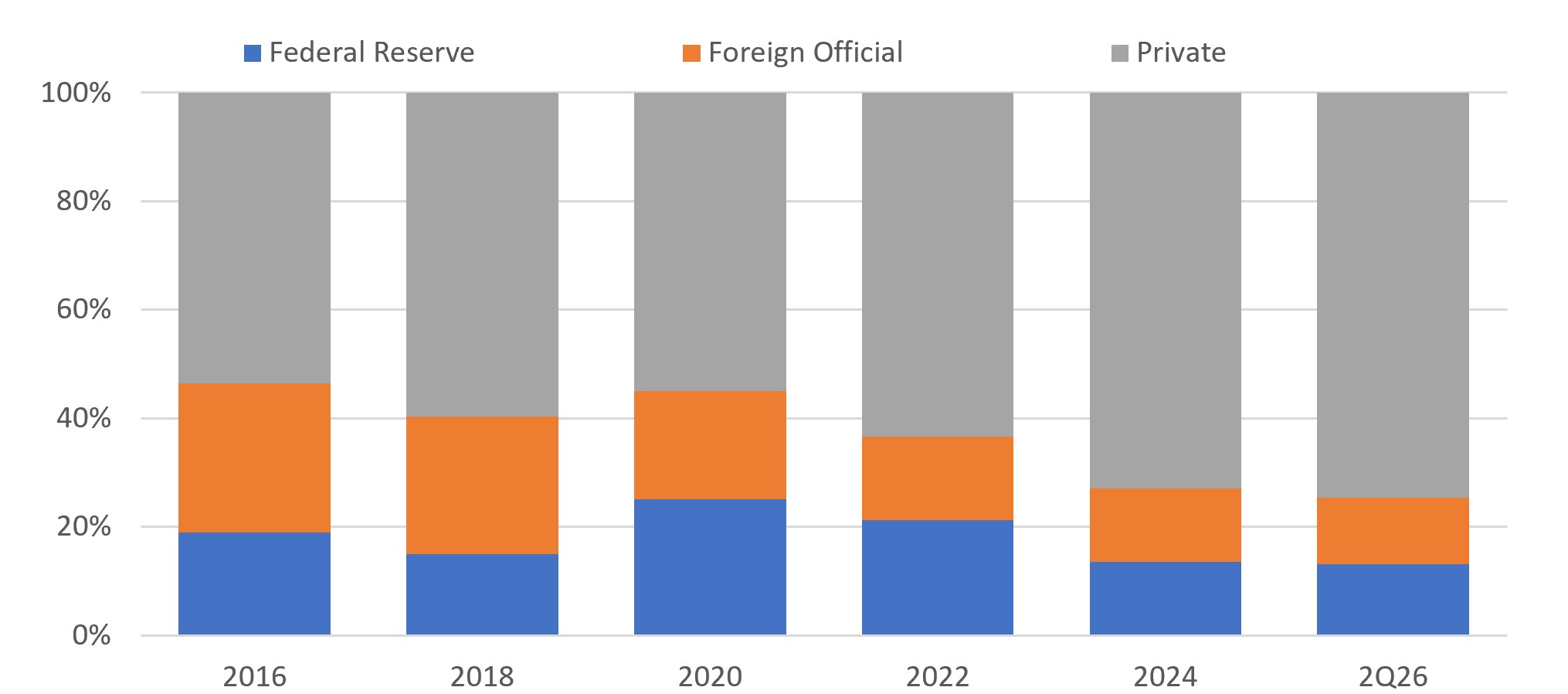
As we discussed in the Fund’s August commentary, the US is running a fiscal deficit of c6% of GDP. At the same time, Treasury ownership has shifted towards more price-sensitive investors, whose share has risen to roughly three-quarters today from just over half in 2016 (see the chart below). AI-related financing needs have also added to the competition for capital. As we highlighted in AI debt levels and the Eureka moment for credit markets, AI-related bond issuance alone had reached $380.5bn by mid-August.
Research from MIT in August estimates that the cost of absorbing additional US Treasury debt has more than doubled since 2015, from around 80bps to 187bps today. Higher long-term yields, therefore, appear not to represent market malfunction, but the greater compensation investors now require to hold government debt.
US Treasury ownership: An increasing reliance on private investors (1Q16 – 2Q26) |
 |
| Source: Polar Capital, Federal Reserve Financial Accounts, US Treasury International Capital System; September 2026. |
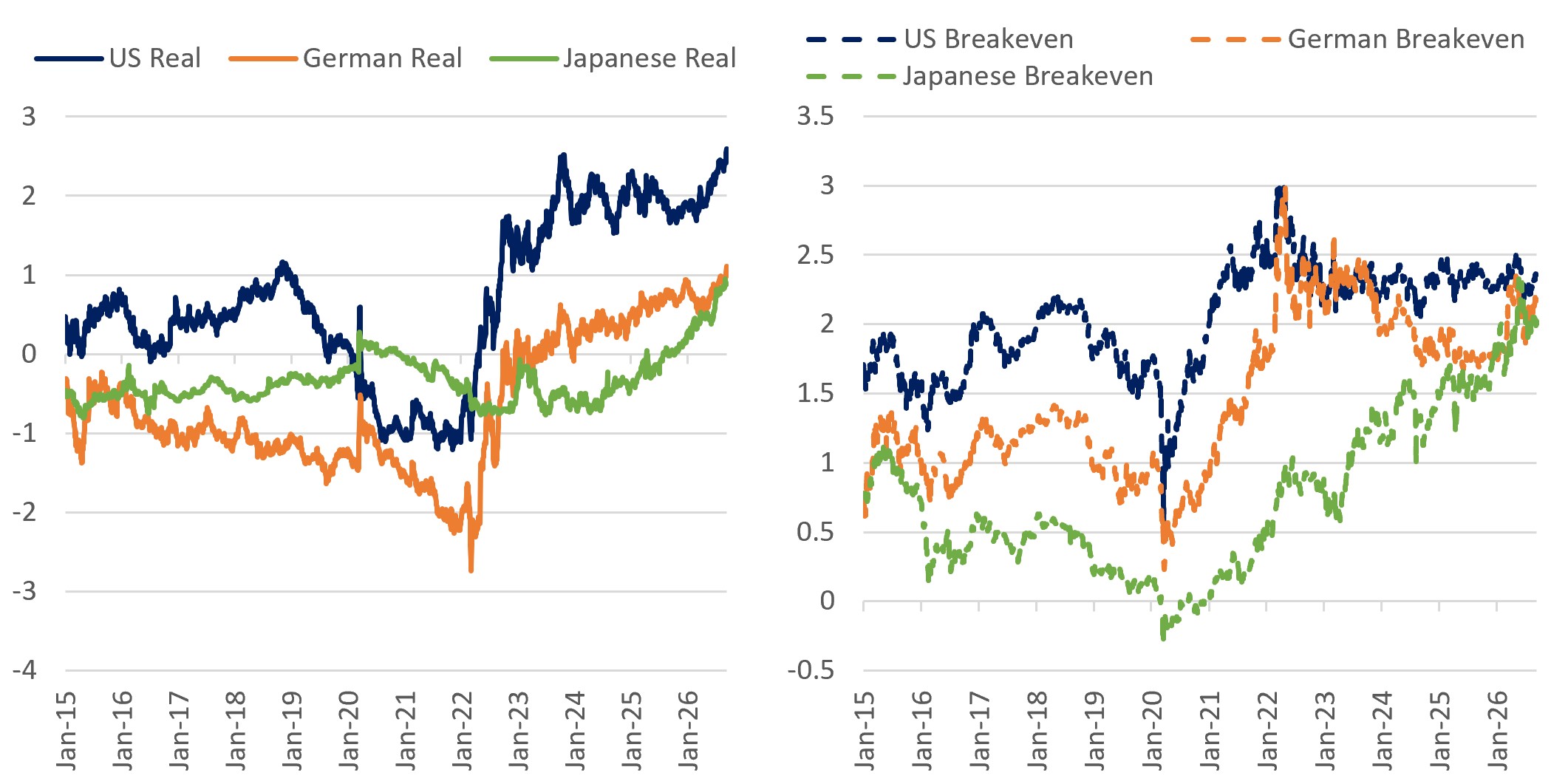
This is not solely a US phenomenon, with long-term government bond yields having risen across major developed markets, predominantly driven by higher real rates (see chart below).
Higher global yields driven by real rates: 10yr real rates & inflation breakevens (Jan 2015 – Sep 2026) |
 |
| Source: Polar Capital, Bloomberg; September 2026. |
Bessent’s response
Bessent is increasingly seeking to manage that price. The US Treasury has expanded its long-dated bond buybacks, while changes have also been made to bank leverage rules and short-term issuance plans. Any future currency intervention is expected to use the Federal Reserve’s Foreign and International Monetary Authority (FIMA) repo facility, allowing foreign central banks to exchange Treasuries for dollars rather than sell them.
Such measures can influence near-term pricing by managing expectations, but if higher yields primarily reflect changed fundamentals rather than dysfunctional markets, intervention faces a more challenging task. Recent experience is instructive. The expansion of long-dated bond buybacks to $6bn, announced on 9 September, did not prevent yields from continuing to rise: the US 10-year Treasury hit its highest level since 2023, while the 30-year equivalent returned to the level seen before the August buyback announcement.
Bessent’s choice of language is particularly striking especially when set against how the political strategist James Carville once viewed the bond market. Carville famously said that, if reincarnated, he wanted to return as the bond market because “you can intimidate everybody”.
Conclusion
His interventions may ultimately prove successful, yet an informational advantage over policy intentions is not necessarily an informational advantage over market outcomes, particularly when the fundamentals underlying those markets have changed.
Croesus’s mistake was not that his information was wrong. It was believing it told him more than it did.